
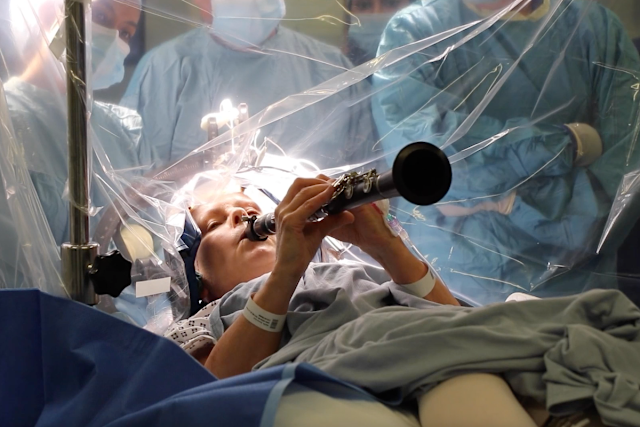
In a London operating room, the soft, familiar sound of a clarinet drifted through the air — not from a concert hall, but from the hands of a woman whose brain was being operated on.
Denise Bacon, a 65-year-old retired speech and language therapist from Crowborough, East Sussex, played her instrument while surgeons at King’s College Hospital performed delicate brain surgery to ease her Parkinson’s symptoms. She stayed awake through the entire four-hour procedure.
“I remember my right hand being able to move with much more ease once the stimulation was applied,” Bacon said afterward. “That in turn improved my ability to play the clarinet, which I was delighted with.”
For years, Parkinson’s had taken away what she loved most. Diagnosed in 2014, she struggled to walk, swim, dance, and play music. She had been forced to give up her seat in the East Grinstead Concert Band five years ago when her tremors made holding the clarinet impossible.
The operation she underwent — deep brain stimulation, or DBS — is a treatment reserved for certain patients whose symptoms can’t be managed by medication alone. The surgery involves implanting thin electrodes into the brain, connected to a pulse generator that sends controlled electrical signals to targeted regions. The result, in some cases, is a near-instant improvement in mobility, speech, and tremor control.
Professor Keyoumars Ashkan, who led the procedure, said his team drilled two openings into Bacon’s skull, each smaller than a five-pence coin. Using an advanced mapping system he described as “a kind of sat nav for the brain,” they navigated to the exact regions controlling her motor function.
“We were delighted to see an instant improvement in her hand movements, and therefore her ability to play, once stimulation was delivered,” Ashkan said.
Bacon’s clarinet wasn’t just symbolic. Playing it in the operating room gave surgeons real-time feedback on whether the electrical current was hitting the right spot. Each note, each steady movement of her fingers, was proof that the signals were connecting — that the brain, even under duress, can still perform its symphony of coordination and control.
“I’m already experiencing improvements in my ability to walk,” Bacon said. “I’m keen to get back in the swimming pool, and on the dance floor to see if my abilities have improved there.”
Doctors have used DBS for years to treat conditions like Parkinson’s and essential tremor, but the sight of a musician performing mid-operation never loses its power. It is medicine and humanity at their most intertwined — science giving back something illness had taken away.
As the last notes faded in the surgical suite, Bacon’s joy was unmistakable. For the first time in years, she wasn’t just playing again — she was herself again.



