
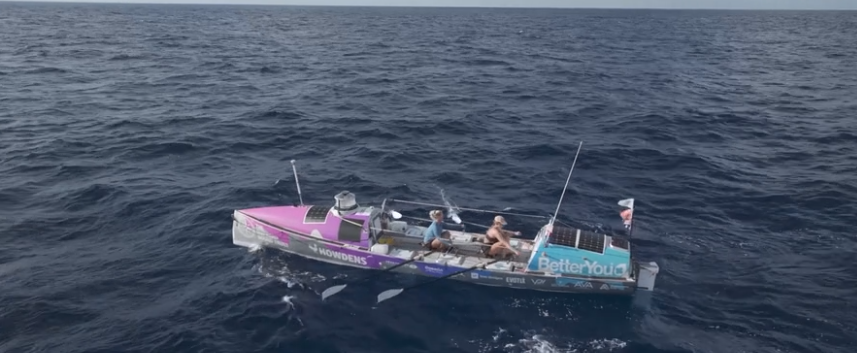
Two British women, Miriam Payne and Jess Rowe, aged 25 and 28, have completed a non-stop, unsupported row across the Pacific Ocean, covering 8,213 nautical miles from Peru to Australia.
The expedition began with a relaunch in May after rudder failure foiled an earlier April attempt. The vessel, a 9-meter craft dubbed “Velocity,” carried more than nearly 900 pounds of freeze-dried food, solar panels, a desalination unit, and a growing unit onboard for micro-greens. The women also cleaned their clothes by soaking them in a bucket with laundry detergent and seawater. Payne, who is from Yorkshire, and Rowe, from Hampshire, committed to daily shifts of around 15 hours at the oars.
Throughout the crossing, the duo encountered severe conditions that included waves up to 30 feet high, sleepless nights, blistered hands, and power failures. Navigation and survival were complicated by isolation and the sheer scale of the Pacific. The pair alternated two-hour shifts at night, sleeping in a small cabin at the front of the boat.
By completing this voyage, the British women became the first all-female pair to row nonstop and unsupported across the Pacific from South America to Australia. Their exact finish date was October 18, 2025, in Cairns, Australia, with the duo finally arriving at 6:42 pm local time after the final stage of their journey was delayed by strong tides in the channel.
The accomplishment contributes to the growing field of extreme ocean-rowing achievements and further establishes women as pioneers in endurance adventuring. While the athletes have crossed the finish line, the implications reach beyond personal triumph. Their fundraising campaign raised more than £86,000 for youth development via the Outward Bound Trust, far surpassing earlier targets of £50,000 and £75,000.
The journey also highlights how ocean-rowing challenges require not only physical endurance but precise planning, resilience in the face of mechanical breakdown, and the psychological stamina to maintain focus for months on end. The pair faced shifting weather systems, large container-ship lanes, and long stretches without conventional rest.
“Those final few hours were brutal,” Rowe told The Guardian, finally standing on land.
“The wind was pushing us off the channel, and we honestly thought we weren’t going to make it. We ended up outside the channel and thought we might have to swim to shore. To finally be here, after talking about it for so long, just feels incredible.
“We still can’t quite believe it’s real. After so many days at sea, to finally see land, and the welcome we’ve had here in Cairns, is beyond words.”
The two women were already quite accomplished: For her part, Rowe has previously crossed the Atlantic Ocean, trekked England’s South West Coast Path, climbed Mount Kenya, and bicycled across Spain. Miriam Payne accomplished this row despite being from a landlocked area; before she joined a team, she was focused on horse riding, sports, and was involved in a climb of Mount Kilimanjaro.
Sources: The Guardian, Reuters



