
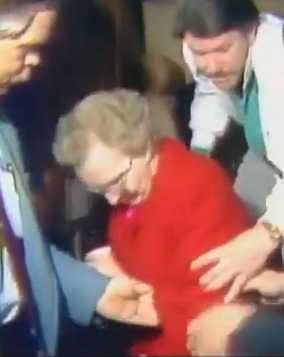
The unassuming Victorian home at 1426 F Street in Sacramento should have been just another boarding house, but it became the site of one of California’s most shocking serial crime stories. In 1988, police discovered seven bodies buried in its yard, uncovering the deadly secret of landlady Dorothea Puente, a seemingly kind caretaker who preyed on the vulnerable. Puente operated the house as a boarding home for the elderly and disabled, but behind the scenes, she was poisoning tenants and cashing their Social Security checks. Convicted of three murders but suspected of many more, Puente spent the rest of her life in prison, dying in 2011. Decades later, her story continues to intrigue filmmakers, true crime audiences and those who continue to visit out of curiosity the house where her crimes were committed.
The Boarding House of Secrets

During the 1980s, Puente gained a reputation as a charitable woman who offered housing to people struggling with mental illness, addiction or homelessness. Social workers referred clients to her boarding home, unaware of her hidden motives. Behind closed doors, Puente drugged and killed some of her tenants, continuing to collect their benefits after their deaths. When concerned caseworkers began asking questions about missing residents, Puente offered conflicting explanations. Her carefully maintained image as a caring “grandmotherly” figure allowed her to avoid suspicion for years, even as neighbors complained of strange smells in the backyard of her F Street home.
Discovery and Arrest

Crime scene tape. Photo taken Tuesday, March 18, 2025, in Lafayette, Ind.
In 1988, police began searching Puente’s property after a social worker reported one of her clients missing. Detectives initially found nothing amiss inside the home but decided to dig in the yard. What began as a welfare check turned into a homicide investigation when officers unearthed human remains in November of that year. Over the following days, six more bodies were found. Despite the grisly evidence, Puente was not immediately detained and managed to flee Sacramento. A four-day manhunt ended in Los Angeles, where she was recognized by a man who had seen her story on the news. She was arrested and charged with multiple murders.
Trial and Life in Prison

The jury box in the courtroom of the Rhea County Courthouse in Dayton, Tenn., Thursday, April 17, 2025.
Puente’s trial began in 1992, lasting several months and drawing national attention. Prosecutors accused her of killing nine people, though she was ultimately convicted of three murders after one of California’s longest jury deliberations. The elderly defendants she targeted, which a prosecutor often referred to as “shadow people,” were difficult for the jury to identify with, yet the scale of her crimes was undeniable. Sentenced to life in prison without parole, Puente maintained her innocence, insisting she had never harmed anyone. In interviews conducted shortly before her death in 2011, she described herself as religious and routine-driven, claiming her days were spent praying, reading and washing clothes for other inmates.
The House and Its New Owners

A home with a sold sign even before full construction sits in the South Pointe neighborhood on Wednesday September 1, 2021. Sold House South Pointe
In 2010, more than two decades after the murders, the infamous home at 1426 F Street was sold to Barbara Holmes and Tom Williams for $215,000. Despite the property’s grim history, the couple embraced its past, hoping to “overcome the stigma.” Williams, a mystery enthusiast, displayed historical photos and even added a mannequin resembling Puente on the porch, drawing curious visitors from around the world. Today, the home is both a private residence and a macabre landmark, attracting those fascinated by true crime. Holmes and Williams say that people still stop by daily to see where Sacramento’s most notorious crimes took place.
Pop Culture and Ongoing Fascination

A close-up of a video camera is featured inside the DeLorean DMC-12, a replica of the car in the Blues Brothers, at Banning Park near Newport, October 25, 2024. Damian Muzzi, owner of Delaware Star Cars, builds replicas of famous cars from movies and TV shows.
Puente’s story has inspired numerous books, documentaries and films. In 2025, filmmaker Chad Ferrin released “Dorothea,” a darkly humorous horror film inspired by her crimes. The movie, though not a factual retelling, reimagines her story with dramatic flair, showing how her infamy continues to influence popular culture. True crime fans remain captivated by the contrast between Puente’s grandmotherly image and her predatory actions. Journalists and filmmakers alike note that her gender, age and manipulation of society’s most vulnerable make her case uniquely disturbing. More than 30 years later, Dorothea Puente’s legacy endures as part cautionary tale and part symbol of the darkness that can hide behind a façade of kindness.
Sources: NBC Bay Area, People, Sactown Magazine, Sacramento Bee



