
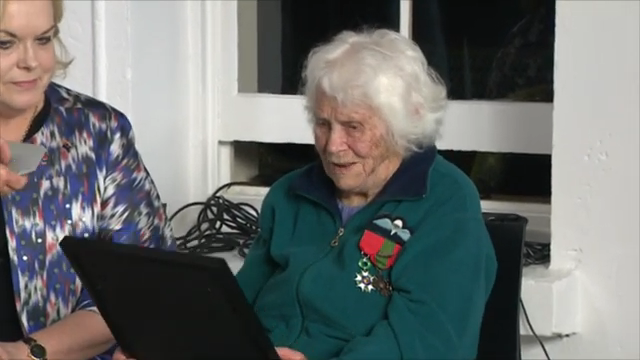
Phyllis “Pippa” Latour Doyle, who passed away in New Zealand at the age of 102 in 2023, was the last surviving female agent of Winston Churchill’s Special Operations Executive (SOE). During World War II, she served behind enemy lines in Nazi-occupied France, gathering intelligence crucial to the Allied invasion of Normandy. Known by codenames such as “Genevieve,” she risked her life transmitting coded messages to London. Her courage earned her high honors from both Britain and France. Though she rarely spoke publicly about her missions, newly released archives and tributes from veterans’ organizations have shed light on her extraordinary contributions to one of the most dangerous branches of wartime service.
Childhood and Early Life

Phyllis Latour was born in 1921 in South Africa to a French father and British mother. Orphaned at age four, she was raised by an uncle in the Belgian Congo, where she developed a love of exploration and adventure. She spent much of her youth traveling through remote areas as her uncle worked to prevent ivory smuggling. Her upbringing gave her independence and adaptability, qualities that would later serve her well as a covert operative. Fluent in English, French, and a few African languages, she attended school in Kenya before traveling to Europe in 1939. When war broke out, she sought a way to serve and joined the Women’s Auxiliary Air Force in 1941.
Path to the Secret War

1943 Army Air-core WWII map printed on parachute fabric.
Latour’s time in the Women’s Auxiliary Air Force left her restless for more-challenging work. In 1943, she volunteered for the Special Operations Executive, the organization responsible for espionage and sabotage in occupied Europe. Her early training reports underestimated her, describing her as naïve and overly cheerful, but she quickly proved capable under pressure. She trained in parachuting, wireless communication, weapons handling and unarmed combat. Despite her small stature, she excelled at wireless operations — a skill crucial for agents behind enemy lines. By early 1944, she had completed her training and was assigned to an SOE network in France under the codename “Genevieve,” preparing for one of the most dangerous missions of the war.
Behind Enemy Lines

In May 1944, Latour parachuted into occupied Normandy disguised as a young French girl. Working with the Resistance, she transmitted vital intelligence to London, including enemy troop positions and supply routes. Her coded messages guided Allied bombing missions and supply drops ahead of the D-Day invasion. To conceal her codes, she wrapped silk message strips around knitting needles and hid the messages inside a shoelace that she would use as a hair tie. Operating under constant threat of discovery, she completed more than 130 transmissions during the campaign. When Allied forces arrived, she made contact but was briefly detained until her identity was confirmed. Her bravery under constant danger earned her recognition as one of the SOE’s most effective field agents.
Life After the War

After the liberation of France, Latour returned to Britain, hoping to continue working in intelligence. However, as the war ended, opportunities for women in espionage were limited. She was commended for her service and awarded the Member of the British Empire (MBE) and France’s Croix de Guerre. Like many SOE veterans, she struggled to adjust to postwar life after years of high-risk missions. Eventually, she left Europe, marrying and living in a few countries before settling in New Zealand. Though she rarely spoke about her experiences, her courage remained recognized within military and veterans’ circles throughout her life.
Later Years and Legacy

In her post-war years, she used the name Pippa Doyle and lived quietly in New Zealand. As she grew older, she was supported by the Royal Air Force Benevolent Fund. Her achievements received renewed recognition late in life. In 2014, she was made a Chevalier of France’s Legion of Honour, and in 2020 a street—Genevieve Lane—was named in her honor at an old Royal New Zealand Air Force base. When she passed away in 2023 at age 102, tributes poured in from across the Commonwealth. The Royal New Zealand Returned and Services Association called her an “incredible woman” whose wartime courage helped change the course of history. Her story remains a testament to quiet bravery and unwavering duty.
Sources: BBC, Royal Air Force Benevolent Fund, New Zealand Herald



