
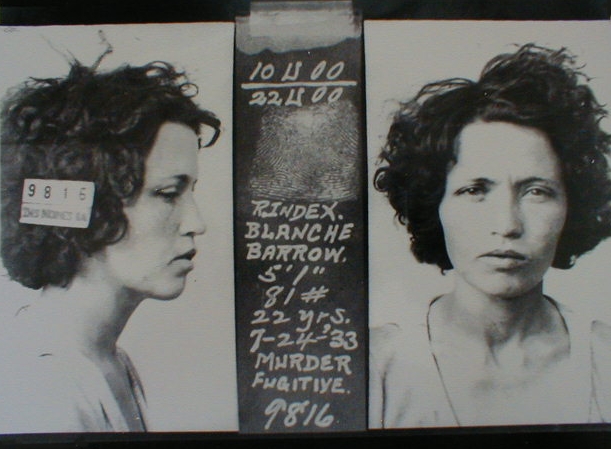
Blanche Barrow’s life offers a lesser-known but deeply revealing perspective on the infamous saga of Bonnie and Clyde. Though her time as a fugitive lasted only months, her devotion to her husband, Buck Barrow, who was Clyde’s brother, drew her into one of the most violent and widely publicized crime sprees of the 1930s. Unlike her more notorious counterparts, Blanche did not embrace crime. Instead, she endured it, torn between loyalty and fear, love and survival. Her experiences, from an abusive marriage to imprisonment and eventual redemption, reveal how one woman’s choices placed her at the heart of America’s “Public Enemy” era.
A Difficult Beginning and a Dangerous Love

Inside the Bonnie and Clyde Ambush Museum in Gibsland, Louisiana.
Born Bennie Iva Caldwell in rural Oklahoma in 1911, Blanche Barrow’s childhood was marked by instability and hardship. She was raised mostly by her father, but her mother forced her into an early arranged marriage to an abusive older man, John Calloway, at just 17. The violent relationship left her unable to have children and desperate to escape. While hiding from Calloway, Blanche met Marvin “Buck” Barrow, an escaped convict with a disarming charm. Despite learning of his criminal past, Blanche fell deeply in love. They married in 1931 soon after her divorce was finalized. Hoping to turn their lives around, she convinced Buck to surrender to authorities to finish his prison term — a decision that would later earn him a pardon but ultimately pull her into a world she never wanted to enter.
Joining the Barrow Gang

Inside the Bonnie and Clyde Ambush Museum in Gibsland, Louisiana.
When Buck was released from prison in 1933, Blanche wanted to try to build an honest life. But their peace was short-lived. Buck’s younger brother Clyde and his companion Bonnie Parker arrived unexpectedly, urging Buck to rejoin them. Blanche objected but reluctantly agreed to accompany her husband. Within weeks, she was traveling with the Barrow gang — a group now consisting of Bonnie, Clyde, Buck, Blanche and young gunman W.D. Jones. Blanche disliked their robberies and reckless lifestyle but stayed close to Buck out of loyalty. She often took on domestic duties like cooking and cleaning while the others plotted their next moves. Though she disapproved of their crimes, Blanche’s presence made her guilty by association as the gang’s notoriety grew across the Midwest.
Life on the Run

The Bienville Parish from the day after Bonnie and Clyde were killed in an ambush is on display at the Bonnie and Clyde Ambush Museum in Gibsland, La. Thursday marks the 85th anniversary of the criminal couple’s death just South of the town. 4e9a5577
Blanche lived as a fugitive, constantly moving between stolen cars and safe houses. The Barrow gang’s crimes, including robberies, kidnappings and shootouts, drew national headlines, turning them into symbols of the “Public Enemy” era. Blanche, who described herself as fearful but devoted, often acted as caretaker to the group. Despite her unease, she bonded with Bonnie, finding in her a mixture of toughness and vulnerability. The two shared conversations as gunfire and danger loomed large in their lives. Blanche later recalled that humor was their way of coping — a fragile defense against the violence that surrounded them. Her brief time with the gang was marked by fear and a growing realization that their lives were spiraling toward tragedy.
The Platte County Shootout and Arrest

The original Bonnie and Clyde ambush site marker, left, was erected in 1972 and has been defaced by souvenir hunters over the years. A new monument was erected in 2014. Thursday marks the 85th anniversary of the criminal couple’s death just south of the town. 4e9a5618
In July 1933, the gang was living in a cabin near Platte City, Missouri. After police traced a stolen car to their hideout, a nighttime raid erupted into a deadly gunfight. Blanche’s warning to Buck triggered the shootout. Shattered glass blinded her in one eye as bullets tore through the cabin. Buck was gravely wounded, but Blanche stayed by his side, helping him escape under heavy fire. The fugitives hid for a week before being cornered again; Buck was fatally shot, and Blanche was captured. Her arrest ended her four-month run with the Barrow gang. Bonnie and Clyde escaped but were killed less than a year later in Louisiana, bringing an end to one of America’s most infamous outlaw stories.
Prison, Freedom and Redemption

Caption: Screaming defiance at the officers who captured her and her husband, Mrs. Marvin Barrow was held as the posse found them in a wooded tract near Dexter Monday. Barrow, badly wounded, is in center of group of kneeling men. Photo by C.H. (Herb) Schwartz, Tribune Staff photographer Published July 24, 1933 Barrow Gang
Following her capture, Blanche was charged with assault with intent to kill, even though she never fired a weapon. Interrogated by federal agents, she refused to betray Bonnie and Clyde, claiming she joined the gang only out of devotion to her husband. Sentenced to 10 years in prison, Blanche spent six years at the Missouri State Penitentiary, where she underwent treatment for her eye injury and began writing about her experiences. Released in 1939 for good behavior, she quietly remarried a carpenter named Eddie Frasure in Texas and lived a peaceful life until her death in 1988 at age 77. In her later writings, Blanche reflected on her choices and warned others against the false glamour of crime, calling it “a game you can’t win.”
Sources: FBI, Jefferson City Magazine, Find a Grave Memorial



