

When the United States entered World War II after the attack on Pearl Harbor, the country transformed overnight into a war machine — and women were among its most vital moving parts. They built planes, packed ammunition, drove trucks, decoded messages, and nursed the wounded. They also managed homes, raised families, and kept communities running while millions of men fought overseas. It’s easy to reduce that history to a few iconic images — Rosie the Riveter, red bandana tied tight, flexing her arm beside the words “We Can Do It.” But the real story of women in World War II runs much deeper. It’s a story about transformation, not just for a nation at war, but for women’s place in American life.
The Home Front Revolution

When the war began in Europe in 1939, the United States was still recovering from the Great Depression. Isolationism was popular. But once the Japanese bombed Pearl Harbor, the country committed fully to the Allied cause — and that meant mobilizing every resource available. Factories that once built cars began producing tanks. And where men had once stood at the assembly lines, women stepped in to take their place.
They worked as welders, riveters, machinists, and engineers. They assembled munitions, built ships, and stitched parachutes. In New Orleans, women even became streetcar conductors for the first time. Historian Stephen Ambrose later wrote that women “became proficient cooks and housekeepers, managed the finances, learned to fix the car, worked in a defense plant, and wrote letters to their soldier husbands that were consistently upbeat.”
One In Every Four Women Joined The Workforce

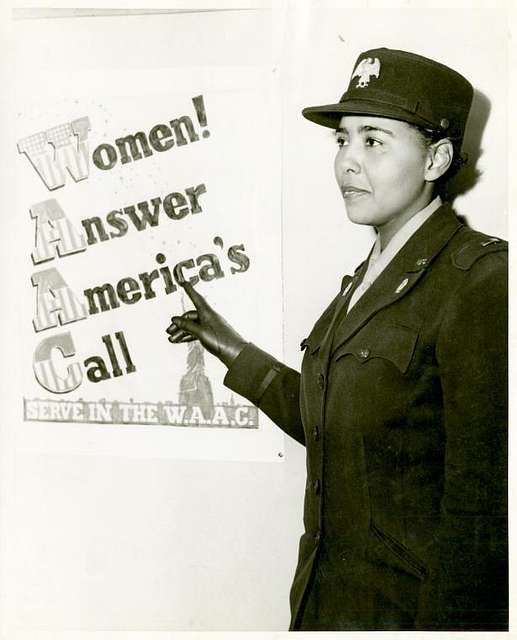
The federal government launched an unprecedented recruitment campaign encouraging women to join the workforce, and millions responded. By 1945, nearly one out of every four married women in the U.S. held a job. Rosie wasn’t just a poster — she was a symbol of a nation’s survival. Nearly 350,000 women also wore the uniform. They joined newly formed branches like the Women’s Army Corps (WAC), the Navy’s WAVES, the Marine Corps Women’s Reserve, and the Coast Guard’s SPARS. The Women Airforce Service Pilots — the WASPs — ferried planes across the country and tested newly repaired aircraft, freeing male pilots for combat missions.
WASPs Were Women In The Skies

The Women Airforce Service Pilots — better known as the WASPs — were a pioneering group of civilian aviators who stepped into the cockpit when the country needed them most. Formed in 1943 from two earlier programs — the Women’s Auxiliary Ferrying Squadron, founded by Nancy Harkness Love, and the Women’s Flying Training Detachment, created by Jacqueline Cochran — the WASPs became the first women in American history to fly military aircraft. These women didn’t serve overseas or fly in combat, but their work was no less vital. They ferried new planes from factories to airbases, tested repaired aircraft, towed targets for live anti-aircraft training, and transported cargo and personnel across the country — all so male pilots could be sent to the front lines. More than a thousand women served as WASPs, flying out of 126 airfields nationwide and collectively logging millions of miles. By the war’s end, they had relocated roughly half of all combat aircraft within the continental United States — an astonishing logistical achievement. But the risks were real. Thirty-eight pilots were killed in crashes, and because they were classified as civilians, their deaths went unacknowledged by the military; families had to pay to bring their bodies home.
Women Played A Major Part in Spycraft

Women also served as spies in the Office of Strategic Services — the precursor to the CIA — where they played a critical role in gathering intelligence and carrying out covert operations. Of the roughly 13,000 people employed by the OSS, around 4,500 were women, and more than a thousand of them worked overseas. Their assignments ranged from clerical work and codebreaking to undercover missions behind enemy lines. Some of their stories sound like something out of a film, except they were real. Claire Phillips, a nightclub performer from Portland, Oregon, operated a spy ring in Manila under the guise of running Club Tsubaki, a cabaret that attracted Japanese officers. Known as “High Pockets” for smuggling messages in her brassiere, she also delivered food and medicine to prisoners of war. Elizabeth Thorpe Pack, another OSS operative, famously helped secure the first Enigma machine from Polish intelligence and obtained critical Axis codebooks through her skill at persuasion. And Virginia Hall — dubbed “the most dangerous of all Allied spies” by the Gestapo — evaded capture for years, organizing resistance networks across France while disguised as a milkmaid. Together, these women helped shape Allied intelligence and laid the groundwork for the modern espionage tradecraft that would follow.
Women Were On The Frontlines As Nurses

Army and Navy nurses worked close to the front lines, treating the wounded in Europe and the Pacific. Sixteen were killed by enemy fire. Sixty-eight American women were captured as prisoners of war in the Philippines. More than 1,600 nurses were decorated for bravery, and 565 women serving in the Pacific theater received combat honors. General Dwight D. Eisenhower once said plainly that he couldn’t have won the war without them. Over 59,000 women served in the Army Nurse Corps and another 11,000 in the Navy, often working close to the front lines in field hospitals, on hospital ships, and in evacuation aircraft. They treated horrific injuries under fire, sometimes performing surgery in tents lit only by flashlights. Sixteen Army nurses were killed in combat zones, and dozens were captured as prisoners of war, particularly in the Philippines. Despite the danger, their courage never wavered. Many received Bronze Stars and Purple Hearts, proving that compassion could be as brave as combat.
After the Victory

When the war ended in 1945, women who had been encouraged to work and serve were told to return home. Men were back from the front. Factories that had churned out weapons now slowed production. Millions of women wanted to keep their jobs — and many said so in surveys taken at the time — but the country wasn’t ready. Most were laid off or pushed out of industrial work. Programs like the G.I. Bill, which helped returning soldiers buy homes and attend college, were far harder to access for women. The same nation that had relied on their labor and loyalty wasn’t yet ready to see them as equals. Still, the war changed everything. It proved that women could do the same work as men, often under greater strain and with less recognition. It expanded their sense of possibility and permanently altered the nation’s expectations.
The Women of World War II Paved The Way

In the decades that followed, the women’s movement would build on the foundation laid by those who had stepped into the factories and barracks of World War II. The war had forced America to ask an uncomfortable question: if women could build planes, fly them, and serve near the front lines — why couldn’t they have equal rights and opportunities in peace? It would take years for the country to answer that question fully, but the women of World War II had already changed the terms of it forever.



