
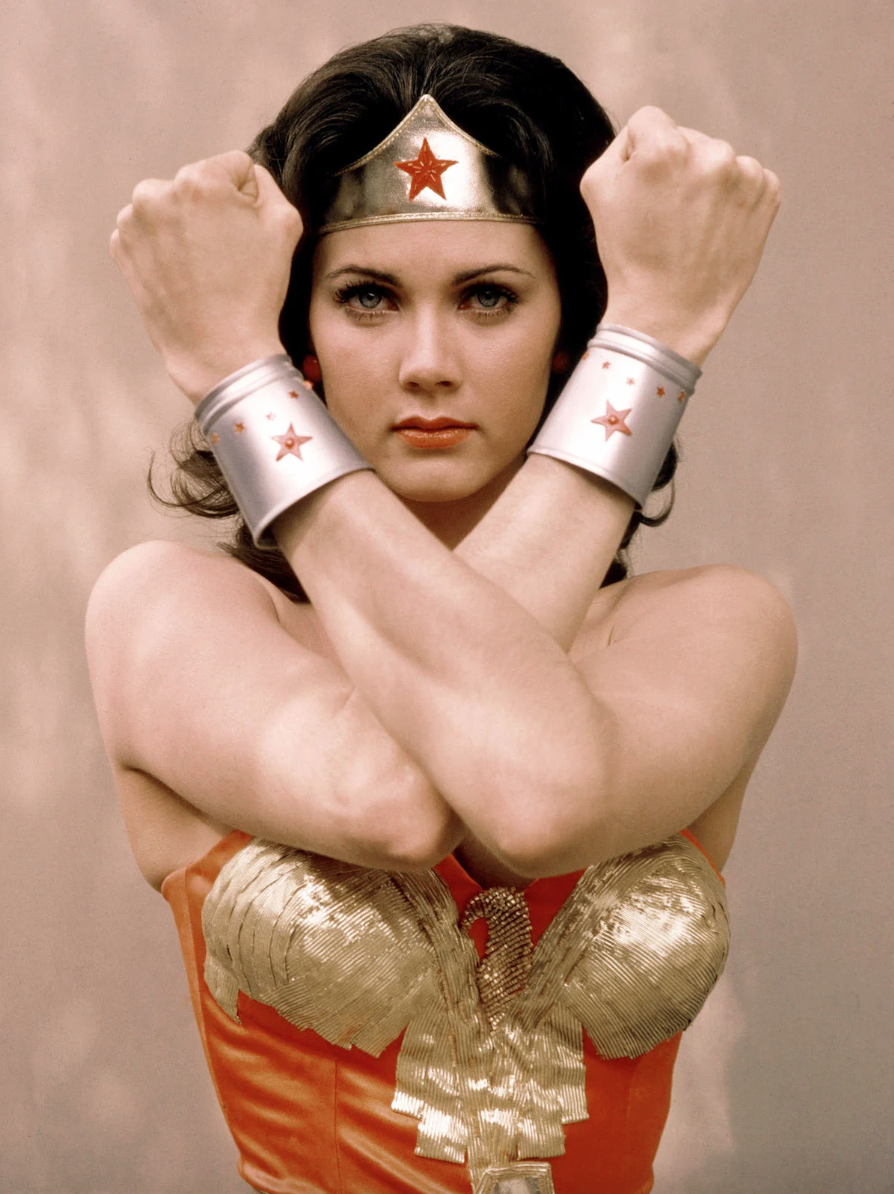

When Wonder Woman premiered in 1975, American television had never seen anything quite like Lynda Carter. A statuesque brunette with a calm confidence and disarming warmth, she wasn’t just playing a superhero — she was one, at least to the millions of women and girls who saw her on screen and realized, for the first time, that strength and femininity could exist side by side. Carter’s portrayal of Diana Prince, the Amazonian warrior turned undercover military officer, didn’t just launch her career — it marked a cultural milestone. She was the first live-action female superhero to headline a television series, and in doing so, she changed what heroism looked like in America.
From Arizona to Paradise Island

Born in Phoenix, Arizona, in 1951, Carter came from an artistic, working-class family. Her mother, Juana Córdova, was of Mexican, Spanish, and French descent, and her father, Colby Carter, was of English and Irish ancestry. From an early age, she seemed destined for the spotlight. She made her first television appearance at age five on Lew King’s Talent Show, sang in high school bands, and performed in Las Vegas lounges as a teenager — sneaking in through the kitchen because she wasn’t yet old enough to enter legally.
She Took The Long Way Around To Acting

Music was her first love. By her early twenties, she was touring with a group called The Garfin Gathering across Nevada’s “Silver Circuit,” singing to casino crowds. But by 1972, Carter realized her ambitions stretched beyond lounge stages. That same year, she won Miss World USA — representing Arizona — and reached the top 15 in the Miss World competition. The title gave her a national profile, and she soon relocated to Los Angeles to pursue acting full-time.
She Had $25 To Her Name When She Was Cast As Wonder Woman

Her career began modestly, with guest spots on Starsky and Hutch and Nakia before her breakout came in 1975. The casting search for Wonder Woman was famously grueling — hundreds of actresses were considered, including Joanna Cassidy and future Charlie’s Angels star Jaclyn Smith. Carter, nearly broke and ready to return home, got the call that would change her life. “I had $25 in the bank,” she later said. “I was about to pack it in when my agent told me I’d landed the part.”
More Than A Comic Book Adaptation

The show’s creators, adapting William Moulton Marston’s 1941 DC Comics character, leaned into the idea of female strength as a moral as well as physical force. In Carter’s hands, Diana Prince was never cynical, never cruel, and never apologetic about her compassion. Carter also added her own creative touch to the show. When producers struggled to depict Diana’s transformation into Wonder Woman, Carter herself suggested the now-iconic spinning motion — a move that became inseparable from the character and was later adopted in the comics and animated adaptations.
Lynda Carter Rocked The Magic Lasso

The Wonder Woman series ran from 1975 to 1979, first on ABC and later CBS, spanning both a World War II setting and a modern-day Cold War backdrop. It was colorful, campy, and sincere in equal measure, with comic book-style transitions, bold music, and patriotic imagery that captured the zeitgeist of the 1970s. But what set it apart was Carter herself. Her portrayal didn’t rely on cynicism or sexuality to sell the character — though she often struggled with being objectified by audiences and the press.
Lynda Carter Paved The Way

In the decades since, other actresses have worn the tiara — most notably Gal Gadot in the modern Wonder Woman films — but Carter’s version remains the blueprint. Even now, she appears at conventions, speaks about the legacy of the character, and embraces her place in pop culture history with grace. Before Lynda Carter, there were no female superheroes leading television shows. After her, there was a template — proof that a woman could carry a franchise, inspire a generation, and redefine what strength looked like on screen. When she spun into that costume for the first time in 1975, it wasn’t just a transformation sequence. It was a revolution — one that started with a single turn and never really stopped spinning.



