
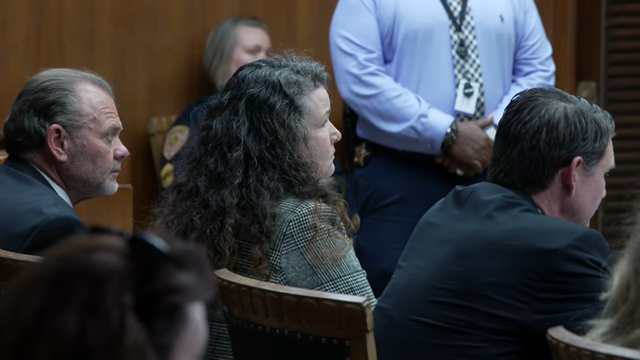
A Texas jury has convicted Sarah Hartsfield of murdering her husband, Joseph Hartsfield, with a fatal dose of insulin. The jury deliberated for about an hour on Wednesday afternoon after sitting through seven days of testimony. Prosecutors argued that Sarah planned her husband’s death and tried to conceal her actions, while the defense maintained that Joseph’s death was a tragic medical event. The trial, held in Chambers County, focused on both the circumstances surrounding Joseph’s 2023 death and troubling events from Sarah’s past. With the guilty verdict now delivered, the court has moved into the sentencing phase. Jurors will determine her punishment, which could include life in prison.
The Fatal Dose That Sparked the Case

A LaPorte County Emergency Medical Service ambulance waits at the LaPorte County government maintenance facility for an insurance inspector to examine it after the ambulance’s driver pulled into the path of a Center Township Fire Department truck Sunday, Aug. 10, 2025, while attempting a U-turn on U.S. 35 outside LaPorte after the two vehicles had been called off an emergency call they had been responding to.
Joseph Hartsfield, 46, was found unresponsive in January 2023 after his wife called 911 from their Chambers County home. He was taken to a Houston-area hospital suffering from severe hypoglycemia, a condition in which blood sugar drops to dangerously low levels. Medical staff noticed that his blood sugar continued to drop even after glucose was administered, leading them to suspect he had been given something to counteract the treatment. Tests later showed he had an excess of insulin in his system, a level high enough to be deadly. The medical examiner ruled his death was caused by complications from insulin toxicity but did not determine whether it was accidental or intentional. Prosecutors said the evidence pointed clearly to murder, while the defense argued that Joseph, who was diabetic, may have accidentally caused his own death.
Evidence and Testimony in the Courtroom

THIS IMAGE HAS BEEN DIGITALLY ALTERED TO PROTECT THE IDENTITIES OF THE INMATES IN ORANGE ON THE LEFT SIDE OF THE FRAME THAT HAD NO OPTION OF STAYING OUT OF THE IMAGE Monroe Circuit Court Judge Mary Ellen Diekhoff speaks during the drug treatment court program in a courtroom in the Zietlow Justice Center on Wednesday, Aug. 6, 2025.
During the trial, prosecutors relied on circumstantial evidence and inconsistencies in Sarah Hartsfield’s story to convince jurors of her guilt. Investigators testified that Sarah’s phone activity did not match her claim that she was asleep on pain medication when her husband fell ill. Instead, data showed she was using her phone regularly that night and deleted messages and internet history afterward. Among the missing messages was a video she had reportedly sent to her daughter showing Joseph gasping before she called 911. Police also noted that several insulin pens were found near Joseph’s bed but were not collected as evidence at the time, which one detective later said she regretted. Prosecutors said Sarah’s access to Joseph’s bank and phone data before his collapse pointed to planning and motive.
A Troubled History Resurfaces

Police tape off a crime scene, Saturday, July 6, 2024, on the 2600 block of Ridgecrest Drive in Florence, Ky.
Much of the prosecution’s case also revisited incidents from Sarah Hartsfield’s past, which they said revealed a pattern of control and manipulation. Jurors heard about a 2018 fatal shooting of her former fiancé, which she claimed was self-defense, as well as allegations that she once asked her then-husband to harm another ex-husband’s wife. Investigators also referenced a 2014 house fire in Missouri that had raised suspicions of arson. Sarah has not been charged in those other cases, but prosecutors suggested they reflected a recurring cycle of violence. The defense objected to this characterization, saying the state was using unrelated accusations to paint her as a bad person rather than proving what happened to Joseph. The defense insisted there was no direct evidence that Sarah injected her husband with insulin.
Family and Witness Accounts

Macomb County Assistant Prosecutor Cory Newman, standing, takes a measurement with defense witness, Charles Funk, during a June 25, 2025 preliminary exam for James Burke, a former Warren police officer charged in the deaths of Cedric Hayden, Jr. and DeJuan Pettis.
Family members offered emotional testimony about Joseph Hartsfield’s final weeks. His sister told the court that Joseph had confided fears for his safety and said he worried his wife might harm him. She said he planned to leave the marriage but never got the chance. Other witnesses described the couple’s strained relationship and growing tension at home. During the sentencing phase, jurors also heard from Sarah’s foster mother and three of her daughters, who detailed years of alleged emotional and physical abuse. They described punishments that were extreme and controlling, including hours-long discipline and isolation. A county jail official testified that Sarah had been involved in a fight while awaiting trial. These accounts were presented to help jurors decide the appropriate sentence following her conviction.
Verdict and Sentencing Phase

One of the hallways leading to a cell block at the Wayne County Correctional Facility shows a U.S. flag painted by an inmate, seen on Tuesday, Jan. 14, 2025. The jail in Indian Orchard, Texas Township, was dedicated in May 2008. It has a capacity to house 186 inmates.
After seven days of testimony and nearly two hours of closing arguments, the jury took just one hour to reach its verdict: guilty of murder. Prosecutors said Sarah’s actions were deliberate and driven by a desire to control her husband’s life and finances, while the defense said the case was based on assumptions, not facts. Assistant District Attorney Mallory Vargas told jurors that Sarah believed she could avoid accountability, pointing to what she called a pattern of people around her meeting tragic ends. Defense attorney Case Darwin countered that the state’s case was built on speculation, comparing it to magic tricks meant to distract from the lack of proof. The case now moves to sentencing, where Sarah Hartsfield faces the possibility of life in prison for the murder of her husband.



