
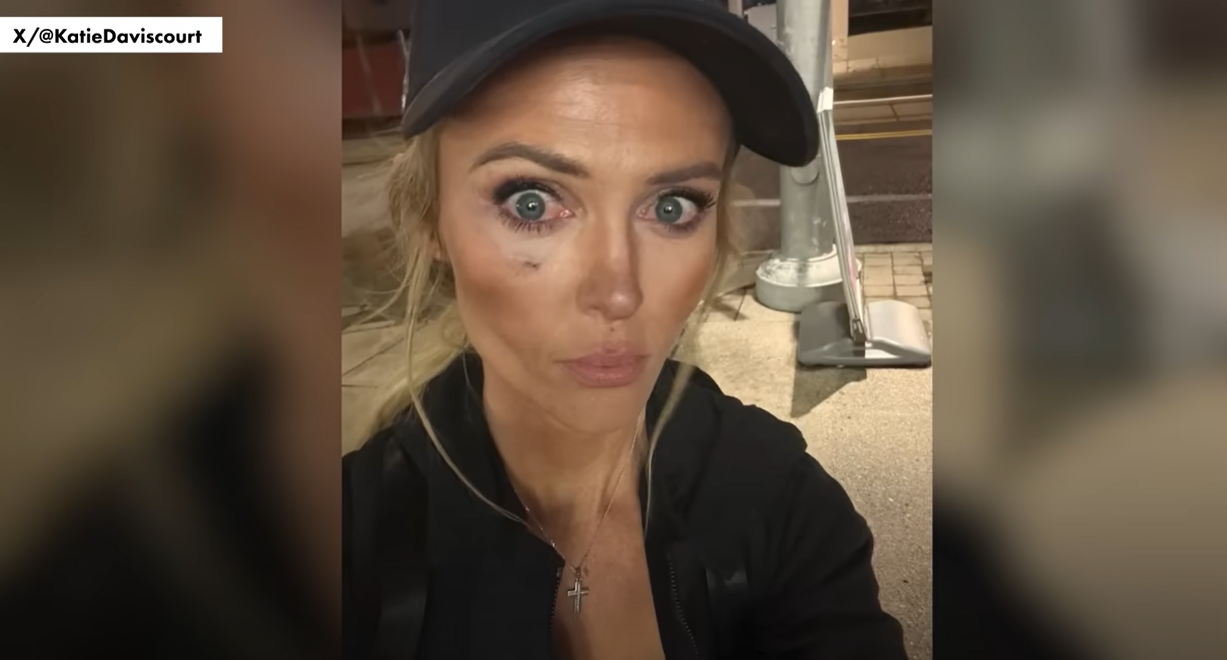
Katie Daviscourt, a journalist with The Post Millennial, says she was assaulted while covering a protest outside the Immigration and Customs Enforcement (ICE) facility in Portland, Oregon. According to her account, the incident happened when demonstrators gathered for another night of protest against immigration enforcement. Daviscourt alleges that one individual, whom she described as affiliated with the “Antifa” movement, struck her in the face with a flagpole. The blow left her with a black eye, which she later displayed in a televised interview. She has since spoken about the challenges of reporting from Portland and her concerns about what she sees as a lack of protection for journalists on the ground. Her statements have sparked debate over press safety, law enforcement’s role in managing large demonstrations, and the ongoing tensions surrounding Portland’s long-running protests.
Daviscourt has explained that the incident occurred while she was filming at the ICE facility in the evening. She said the suspect approached suddenly and swung a flagpole “like a baseball bat,” hitting her across the face. The impact left visible bruising, which she documented and later showed publicly. She recounted immediately chasing the suspect through the crowd and attempting to get help from nearby Portland police officers. According to her, she identified the individual directly and urged the police to make an arrest. She has argued that officers failed to act at a critical moment and that their inaction underscored a pattern of limited response to violence at protests. Her description of events has been widely shared on social media, where she has voiced concerns about what she views as unsafe conditions for the press.
Portland police offered a different account of the events. In an official statement, the department said that a “dialogue liaison officer” attempted to stop the suspect but was ignored. The individual allegedly fled the scene, and the case was later assigned to the Major Crimes Unit. Police said they had met with Daviscourt following the incident to gather details and expressed that they welcome public help in identifying the suspect. They disputed the claim that officers ignored her calls for help, noting that their actions were guided by the need to avoid escalating an already tense protest situation. The department emphasized that the investigation remains ongoing and that no arrests have been made yet.
The episode contributes to a broader discussion about the challenges of covering protests in Portland, where demonstrations have frequently garnered national attention. The city has seen repeated protests outside the ICE facility, with tensions between demonstrators, police, and federal officials. Journalists reporting from these events often find themselves in the middle of conflicts and face risks ranging from verbal harassment to physical violence. Daviscourt’s case highlights the risks associated with covering these protests, as well as the conflicting expectations placed on law enforcement to manage large gatherings while protecting the press. The incident has also been cited in broader conversations about public safety and the responsibilities of police during demonstrations that can quickly turn confrontational.
Taken together, Daviscourt’s account, the police response, and the context of Portland’s protests highlight the challenges of balancing press freedom, public demonstration, and law enforcement responsibilities.
Sources: The Oregonian, New York Post



