
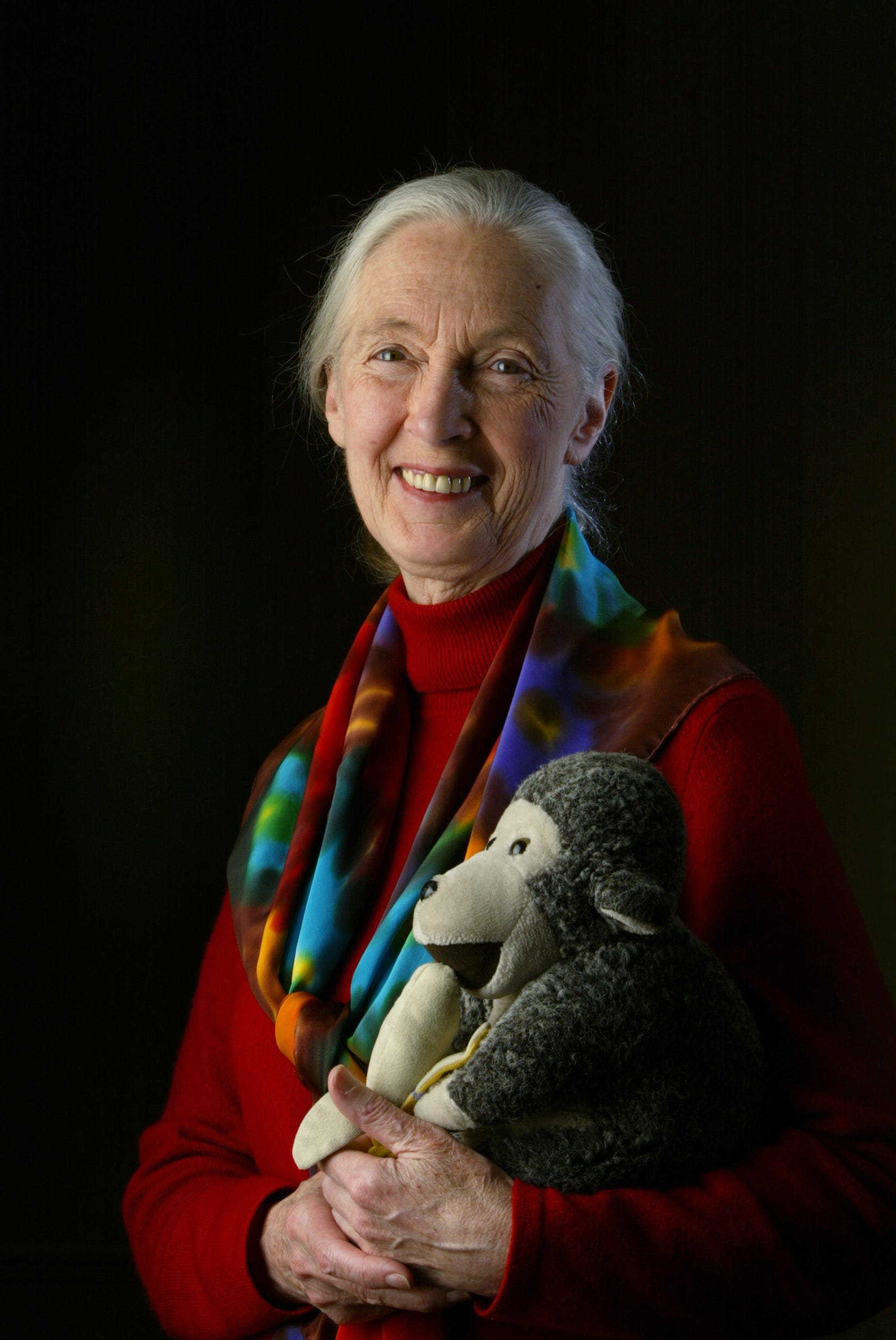

Jane Goodall, with her mascot Mr. H. on March 4, 2004.
Jane Goodall, one of the most influential conservationists and scientists of the 20th century, died in California while on a speaking tour, her institute announced Wednesday. She was 91.
She Changed What We Think About Chimps

Primatologist Jane Goodall talks to local media before giving a presentation to Ohio State University students at the Ohio Union on March 25, 2013.
Goodall rose to prominence in the 1960s when her intimate observations of chimpanzees in what is now Tanzania upended long-held ideas about the natural world. She showed the world that chimpanzees made and used tools forcing scientists to rethink the line separating humans from animals. Born in London in 1934, Goodall arrived at the Gombe Stream Chimpanzee Reserve as a young woman with no formal scientific degree. Under the mentorship of famed paleoanthropologist Louis Leakey, she immersed herself in the lives of the chimps she studied, naming them instead of numbering them. Her early accounts in National Geographic, supported by photographer Hugo van Lawick — who became her first husband — introduced the world to chimps like David Greybeard and Flo as if they were old friends.
She Paved The Way For Female Scientists

After talking to local media, primatologist Jane Goodall sits down to record an interview prior to giving a presentation to Ohio State University students at the Ohio Union on March 25, 2013.
Her discoveries won respect from leading evolutionary biologists like Stephen Jay Gould, who once described her research as “one of the Western world’s great scientific achievements.” But her impact went far beyond the laboratory. At a time when field biology was still dominated by men, Goodall’s visibility helped clear a path for other women scientists, including Dian Fossey and Biruté Galdikas, who went on to make their own groundbreaking contributions to primate research.
The Jane Goodall Institute

After talking to local media, primatologist Jane Goodall sits down to record an interview prior to giving a presentation to Ohio State University students at the Ohio Union on March 25, 2013.
As the years went on, Goodall shifted her focus from observing to protecting. By the 1970s, she was an outspoken advocate for conservation. She spent much of the rest of her life traveling the world, delivering lectures that mixed scientific insight with moral urgency. Her voice — calm, clear, and hopeful — became as central to her legacy as her field notes. In 1977, she founded the Jane Goodall Institute, which today operates in more than 30 countries. Its Roots & Shoots program, launched in 1991, has inspired young people in over 100 nations to take action on conservation and environmental justice. Her work earned her some of the highest honors available, from the Templeton Prize in 2021 to the Presidential Medal of Freedom earlier this year. Queen Elizabeth II made her a dame in 2003.
Above All She Was A Cultural Icon

Primatologist Jane Goodall talks to local media before giving a presentation to Ohio State University students at the Ohio Union on March 25, 2013.
Goodall’s life was not untouched by personal difficulty. She divorced van Lawick in the 1970s and later lost her second husband, Derek Bryceson, to cancer in 1980. Still, she continued to write, to teach, and to campaign. Her books, including In the Shadow of Man and Through a Window, blended science with memoir in ways that resonated far beyond academia. By the time of her death, Goodall was not just a scientist but a cultural icon — her image captured in documentaries, her name attached to a global conservation movement, even her likeness honored as a Barbie doll made of recycled plastic. She had, as her mentor Leakey once predicted, redefined what it meant to be human by showing us just how much we shared with the animals we thought we stood apart from.



