
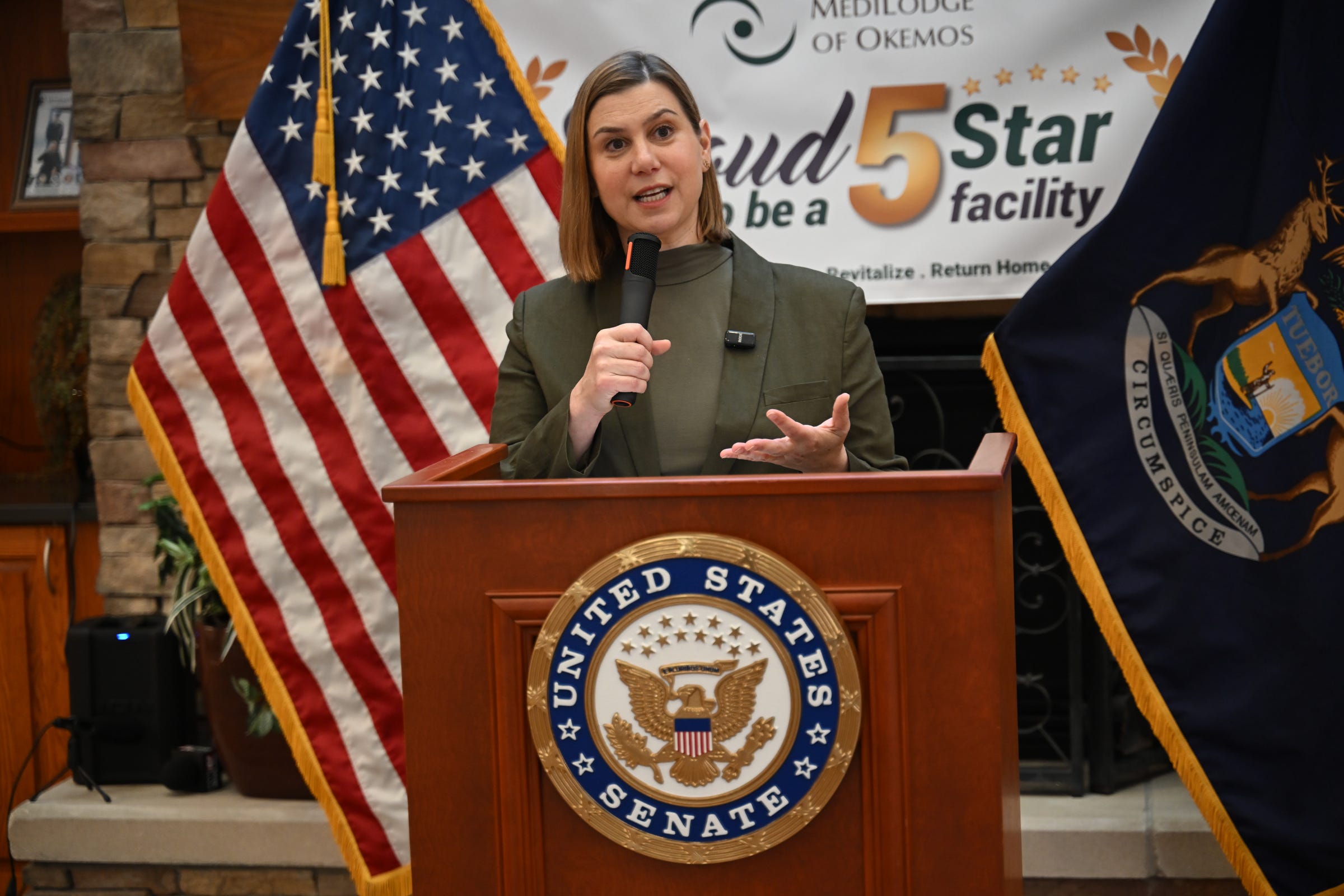

U.S. Sen. Elissa Slotkin speaks about Medicaid during a press conference after touring MediLodge of Okemos nursing care facility on Thursday, April 24, 2025, in Okemos.
Michigan Senator Elissa Slotkin stood on the Senate floor Monday with the heavy task of speaking for a grieving community. The Grand Blanc Township shooting, which left four dead and others wounded inside a house of worship, has stunned a town more accustomed to fender benders and school fundraisers than scenes of mass violence. Slotkin, alongside Sen. Gary Peters, gave voice to what many in her state are struggling to process: grief, disbelief, and a sense that the nation’s recurring nightmare has come home yet again.
A Truly Horrible Day

U.S. Sen. Elissa Slotkin D-Mich. rehearses ahead of giving the Democratic response which will follow President Donald Trump’s speech to a joint session of Congress, in Wyandotte on Tuesday, March 4, 2025.
According to authorities, a man drove his car into a Church of Jesus Christ of Latter-day Saints building during Sunday services before setting the structure on fire and opening fire on the congregation. Within minutes, lives were lost, families torn apart, and another small community was added to the ever-growing list of American towns defined by tragedy.
Sorrow and Urgency

Democratic U.S. Rep. Elissa Slotkin speaks to a small crowd in the early hours of Wednesday, Nov. 6, 2024, during the Michigan Democratic Party election night event at the Motor City Casino Sound Board Theater in Detroit.
Slotkin’s remarks carried both sorrow and urgency. She made a point to highlight the swift action of first responders. Police arrived just 30 seconds after the first 911 call, neutralizing the shooter within eight minutes. It was a reminder, she said, that even in the darkest moments, people step forward. She singled out two officers—one from the Michigan Department of Natural Resources and another from Grand Blanc Township—who risked their lives to confront the gunman. They didn’t wait. They didn’t hesitate. They ran toward danger.
A Particularly American Sickness

Congresswoman Elissa Slotkin, D-Lansing, speaks on Tuesday, March 26, 2024, at the UAW Local 652 headquarters in Lansing.
“We are unwell,” she said, noting how violence has become a recurring language in public life, used in schools, in churches, even in political discourse. She pointed to other recent tragedies—the assassination of activist Charlie Kirk, the attack on legislators in Minnesota, and the assault on the president himself—as evidence of a national breakdown. The details may vary, but the throughline is clear. Too many people believe violence is an acceptable expression of anger, grievance, or ideology.
This Isn’t The First Tragedy That Michigan Has Faced

Community members and supporters gather in Burton, Michigan, on the night of Sept. 28 for a scheduled prayer vigil honoring the life of Charlie Kirk, following a nearby mass shooting in Grand Blanc Township.
Michigan knows this reality all too well. In just four years, the state has endured mass shootings at Oxford High School, Michigan State University, a splash pad in Rochester Hills, and another church in Wayne County. Grand Blanc is now part of that list, what Slotkin called a “sick fraternity” of communities reshaped by mass gunfire. The senator acknowledged what many already feel: repeated exposure to these events risks desensitization. Each new shooting carries a fresh wave of shock, but the horror also piles atop what came before. Over time, the edges dull. That, she warned, is dangerous.
Slotkin Hopes We Can Heal

Mar 4, 2025; Wyandotte, MI, USA; Sen. Elissa Slotkin, D-Mich., rehearses the Democratic response to President Donald Trump’s address to a joint session of Congress Tuesday, March 4, 2025, in Wyandotte, Mich. Mandatory Credit: Paul Sancya-Pool via Imagn Images
Her message, though, wasn’t only about mourning. It was a plea for restraint and responsibility. Slotkin urged Michiganders and Americans alike not to let social media define the moment with half-truths and anger. She called on leaders, and ordinary citizens, to choose healing over division, seriousness over spectacle. She also framed the violence as an assault on freedom itself. If Americans cannot feel safe in churches, schools, or civic spaces, then their basic freedoms are eroded. Fear, she argued, is its own form of tyranny.



