
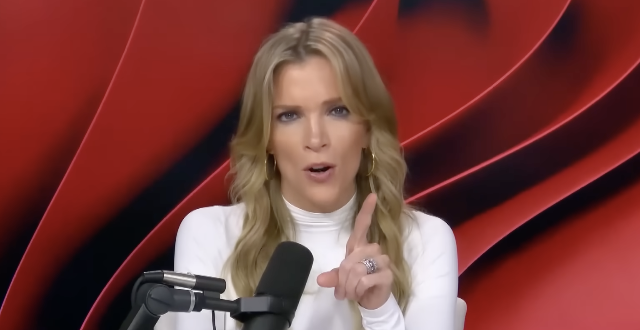
In a recent segment, journalist and commentator Megyn Kelly turned her focus on the role of corporate media in shaping today’s political climate, arguing that it has contributed to division and, in some cases, political violence.
Kelly began by pointing to the power of mainstream outlets in controlling narratives. She questioned whether tragedies, such as the assassination of activist Charlie Kirk or even the assassination attempt on President Donald Trump, might have unfolded differently if the media’s coverage had been less polarizing. According to Kelly, repeated portrayals of conservative figures as “fascists” or “Nazis” fuel hostility rather than dialogue.
She contrasted how Charlie Kirk conducted himself publicly versus how he was sometimes portrayed. While acknowledging that his radio commentary could be sharp, she emphasized that in person Kirk often engaged respectfully with people who disagreed with him. Kelly noted that many young people, particularly young men, have discovered Kirk’s debates online and found them compelling enough to reconsider their own political leanings.
A large part of Kelly’s critique centered on what she described as “gaslighting” — when media figures, in her view, downplay or shift focus away from violence against political conservatives. She cited examples of commentators and columnists whose reactions to Kirk’s assassination struck her as self-centered or dismissive. For instance, she referenced CNN contributor Ashley Allison, who discussed her own feelings about Kirk rather than focusing on the tragedy itself. Kelly dismissed this as making the story “about me.”
She also discussed the case of Karen Attiah, a former columnist for the Washington Post who had previously come under fire for controversial social media posts. After Kirk’s death, Attiah made remarks online resisting calls to publicly mourn him, which Kelly argued reflected insensitivity. Attiah later appeared on other platforms to defend her position, framing her dismissal from the newspaper as part of a larger climate of fear in mainstream journalism.
Kelly’s takeaway was that such responses reveal a troubling inconsistency in how media institutions handle violence, empathy, and accountability. She argued that while journalists often call for compassion and warn against dehumanization, some fail to extend that same standard to figures they disagree with politically.
Her broader concern was about what happens when corporate media dominates public narratives. By amplifying anger and emphasizing division, she suggested, outlets risk normalizing a cycle where political opponents are seen as enemies rather than fellow citizens. For Kelly, this environment not only undermines trust in journalism but also exacerbates real-world consequences, from political polarization to violence.
While sharp in her criticism, Kelly’s remarks ultimately pointed to a call for accountability — not just for politicians or activists, but for the media itself. In her view, if the press continues to frame complex issues in partisan or sensationalist terms, it will remain part of the problem rather than part of the solution.
Source: Megyn Kelly/YouTube



