
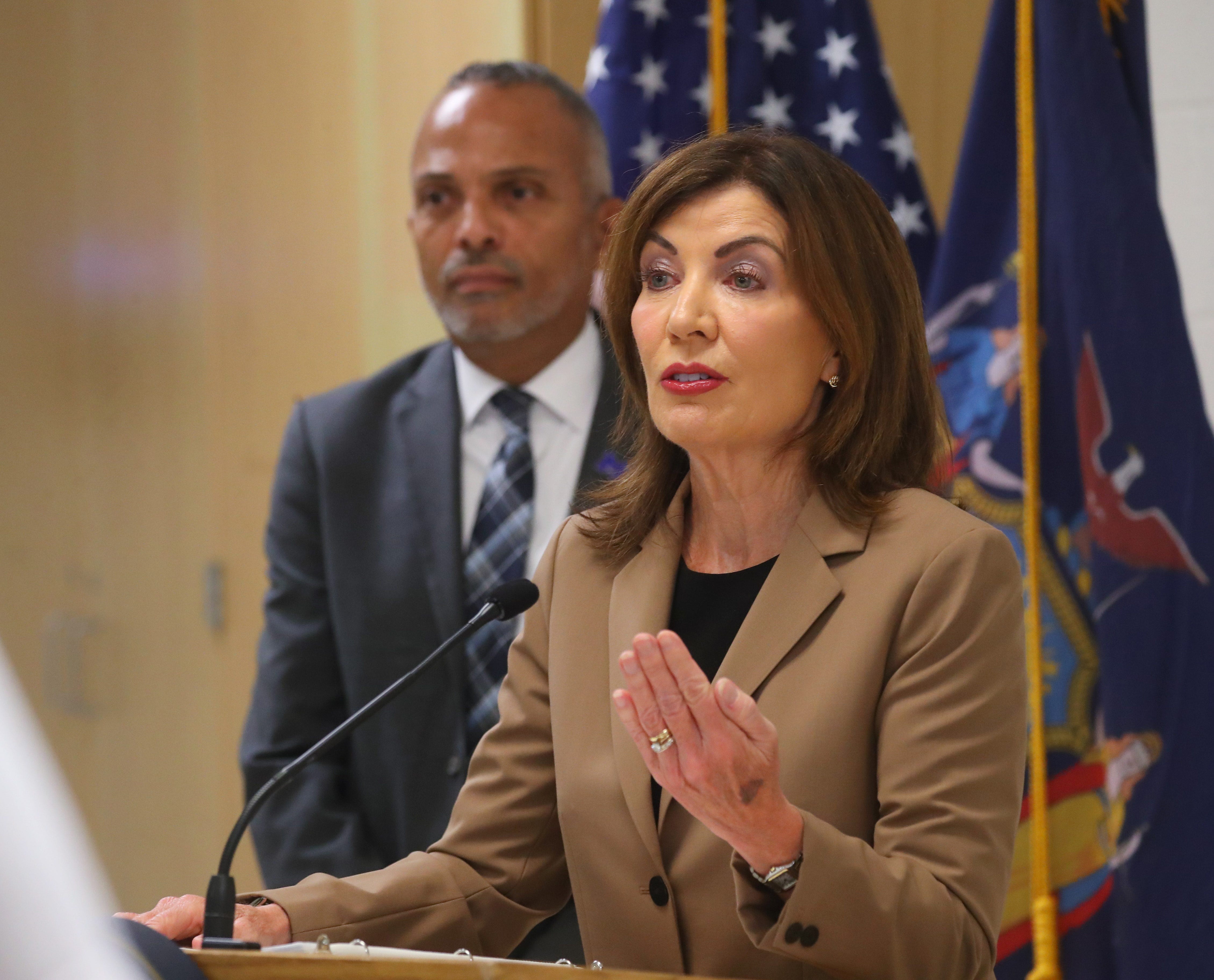
Governor Kathy Hochul signaled this week that she intends to take a hard look at the union work rules that have allowed some Long Island Rail Road employees to nearly quadruple their base salaries through overtime pay.
Her comments came after Newsday reported that certain workers on the LIRR — already the highest paid railroad workforce in the country — were making as much as $240,000 in a single year. Much of that, the report noted, was driven by longstanding work rules embedded in union contracts.
Asked about the story at a press availability, Hochul did not mince words. “Work rules that were put in place a long time ago need to be re-examined in light of today’s circumstances,” she said. “The cost of running the system continues to grow and grow. We need to look, in a responsible way, at some of the drivers of that.”
That acknowledgment places her in line with Metropolitan Transportation Authority chairman Janno Lieber, who has described the issue as one of the MTA’s top priorities in ongoing negotiations with rail unions. Hochul framed it not as an attack on workers but as a necessary adjustment to protect the system’s long-term viability.
“These are the highest-paid railroad workers in the nation,” she said. “And while we respect the work they do, we can’t ignore the strain this puts on the budget and, ultimately, on riders.”
The governor also took the opportunity to jab at former President Donald Trump, who has recently tried to position himself as a champion of commuters by criticizing the MTA’s management. Hochul argued that Trump’s policies had, in fact, worsened the labor dispute, noting that his administration authorized actions that gave unions new leverage in threatening strikes.
“Donald Trump looks like he came in and saved the day, except he didn’t,” Hochul said. “He created the scenario that gave them the ability to strike in the first place. If he had not authorized that, they wouldn’t have had that leverage.”
The governor’s remarks come at a delicate moment. The LIRR is still digging out from the financial impact of the pandemic, when ridership cratered. Recovery has been steady but uneven, and farebox revenue alone still falls short of pre-2020 levels. Federal relief funds helped cover the gap in the short term, but long-term solvency requires difficult trade-offs.
At the same time, riders are dealing with higher fares and continued concerns about reliability. Stories of outsized overtime checks land poorly with commuters who already feel squeezed. Reforming work rules, Hochul suggested, is not about punishing unions but about ensuring that public transit dollars are used wisely.
“It’s about fairness,” she said. “We want to make sure we’re providing reliable service without asking New Yorkers to shoulder more than their share.”
The MTA’s negotiations with labor are ongoing, and any changes will need to be hammered out at the bargaining table. Hochul’s comments leave little doubt about where she stands: work rules that once made sense decades ago may no longer be sustainable in an era of soaring costs and tight budgets.



