
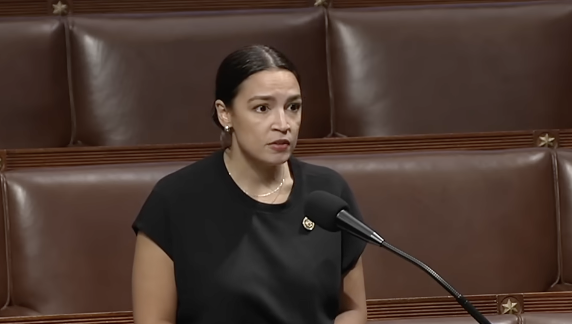
In a floor speech responding to a Republican-backed resolution honoring the late Charlie Kirk, Representative Alexandria Ocasio-Cortez (D-NY) sought to strike a balance between condemning political violence and questioning the decision to elevate Kirk’s record. Her remarks reflected the tension in Congress between honoring victims of violence and reckoning honestly with their public legacies.
Ocasio-Cortez began by denouncing Kirk’s assassination, describing it as “a horrific and vile attack” that reflects the dangerous escalation of political violence in the United States. She emphasized the importance of Congress uniting to unequivocally condemn violence, both to honor victims and to send a stabilizing message to the public during an era of heightened political risk.
But she was equally firm in rejecting the way the resolution framed Kirk’s life and legacy. “We should be clear about who Charlie Kirk was,” she said, before citing some of his most controversial statements. She noted that Kirk had questioned the Civil Rights Act, suggested support for the assailant of former Speaker Nancy Pelosi’s husband, and accused Jewish communities of controlling industries such as Hollywood and higher education.
“These were not the words of a unifier,” Ocasio-Cortez said, calling Kirk’s rhetoric “ignorant” and “disenfranchising” to millions of Americans. In her view, the resolution’s language describing him as a man who worked “tirelessly to promote unity” was inaccurate and painful, particularly for communities historically harmed by racism and discrimination.
The congresswoman criticized the majority party for pushing the measure on a partisan basis instead of pursuing a broader, bipartisan resolution that would condemn political violence without glossing over Kirk’s record. She pointed to the House’s past ability to unite around similar measures, warning that the current approach risked further dividing Congress and the country.
Beyond the resolution itself, Ocasio-Cortez raised concerns about what she described as attempts to exploit the tragedy to restrict free speech. She alleged that President Trump and the Federal Communications Commission had threatened media outlets, including ABC, for airing critical voices. “This is a disgusting attack on the American people and the very First Amendment rights that define us as a country,” she said, urging media organizations to resist censorship.
Even as she pressed her critique, Ocasio-Cortez expressed compassion for Kirk’s family, noting the grief of his wife and children and offering prayers for them in the wake of his death. Her remarks underscored the delicate balance lawmakers face: separating the need to condemn political violence and stand with victims’ families from the responsibility to confront the impact of harmful rhetoric.
The speech highlighted broader divides in Congress. Republicans have sought to frame Kirk as a symbol of free speech and political courage, while many Democrats, like Ocasio-Cortez, argue that his statements caused real harm and should not be whitewashed in official records.
What remains consistent across the aisle is recognition of the urgent need to curb political violence. As Ocasio-Cortez made clear, that condemnation should not come at the expense of truth or the erosion of Americans’ First Amendment rights.
Source: Congresswoman Alexandria Ocasio-Cortez



