
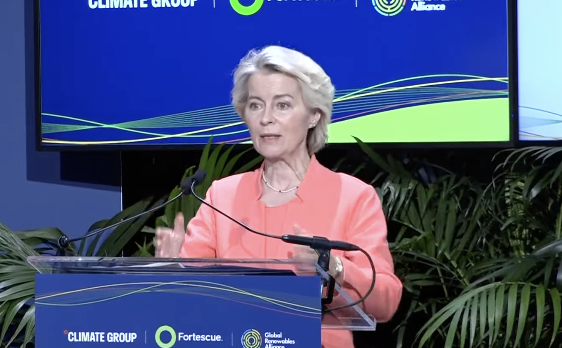
At the Global Renewables Summit in New York, European Commission President Ursula von der Leyen delivered a wide-ranging speech calling for decisive international cooperation to accelerate the energy transition. The summit brought together government leaders, industry executives, and civil society to address both the opportunities and challenges of scaling renewable energy worldwide.
Von der Leyen began by highlighting the economic case for renewables. In 2024, nearly $2 trillion was invested globally in clean energy, she noted, and renewable projects now consistently outcompete fossil fuels on cost. According to her, 90% of new renewable energy projects deliver cheaper power than their fossil fuel counterparts, with solar in particular undercutting the lowest-cost fossil option by over 40%. Still, she stressed that momentum alone is not enough—concrete action and coordination are needed.
She outlined three priorities: Europe’s ongoing energy transformation, building cross-continental partnerships, and advancing global cooperation.
On Europe, von der Leyen recounted how the continent drastically reduced its dependence on Russian energy after the outbreak of the war in Ukraine. Where nearly half of Europe’s gas once came from Russia, the EU pivoted rapidly toward diversification and renewables. Today, almost half of Europe’s electricity is generated from renewable sources, supported by over €100 billion in clean industry investments. These efforts, she said, not only strengthen climate action but also deliver energy security and create jobs at home.
Turning to partnerships, von der Leyen emphasized that energy independence does not mean isolation. She cited the Elmed interconnector project linking Italy and Tunisia, as well as green hydrogen initiatives in North Africa, as examples of mutually beneficial collaboration. Such projects, she argued, are “win-win-win”—supporting climate goals, creating employment, and enhancing energy security across regions. Through its Global Gateway program, the EU is investing €300 billion by 2027 in infrastructure projects abroad, including renewable energy efforts in the Caribbean and Kenya.
Globally, von der Leyen urged governments and industry leaders to sustain political momentum behind the pledge to triple renewable capacity and double energy efficiency by 2030. She pointed to the newly launched Global Energy Transition Forum as a mechanism for accountability, stressing that progress must be tracked to ensure promises translate into results.
She acknowledged the challenges that still deter investment, such as high capital costs and risk premiums in developing countries. To address these barriers, she called for more creative risk-sharing and public-private partnerships. Speaking directly to investors, she invited them to articulate the guarantees and regulatory conditions they need to commit resources at scale. In return, she urged companies to bring their capital and innovation to regions where renewable deployment can have the greatest impact.
Von der Leyen closed with a vision of a “new age of renewable abundance” in which affordable, clean energy underpins both prosperity and security. Only by ensuring the benefits are shared globally, she said, can the transition succeed.
Source: European Commission



