
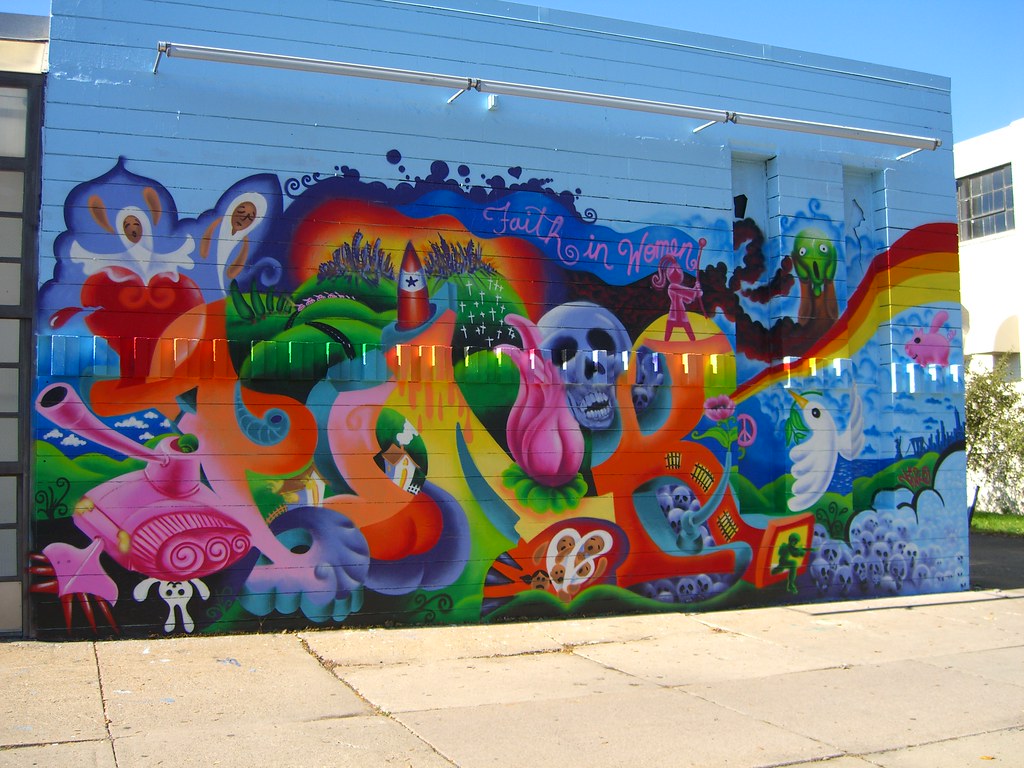
Lady Pink’s career has always been about defiance—about refusing to accept the boundaries that the art world, or society at large, tried to impose. Born in Ecuador and raised in Queens, she was just a teenager when she picked up a spray can and decided to claim space in the rough, male-dominated world of late-1970s New York graffiti. Now, decades later, she has returned to MoMA PS1 with a new mural that nods to her beginnings and reasserts what graffiti has always been about: creativity born in rebellion.
The mural, titled Foundations, was unveiled this month in Long Island City. It stretches across a massive wall facing the site of the former 5Pointz building, the fabled mecca for graffiti artists from around the world that was demolished in 2014. Now it’s gone, but this work is called Foundations because street art itself is the foundation of all art.”
The mural is vibrant, layered with her signature bold colors and sweeping lines, but it also carries a deeper message. To Lady Pink, graffiti has always been more than spectacle. “It’s about children and young people doing art for the fun of it,” she explained. “We all did it in kindergarten, and now we’re grown-up artists. That’s the root.”
For MoMA, the installation is both a recognition of Lady Pink’s influence and a reminder of how far graffiti has come. Once derided as vandalism, it’s now canonized inside institutions that once dismissed it. Lady Pink herself acknowledges the irony. “Let’s get this straight—it is still vandalism if you put it somewhere that doesn’t belong to you,” she said. “But we took it above ground. We were invited into galleries, museums, motion pictures. We were showered with money and books. And then we never looked back.”
Lady Pink has always been unflinching about her place in that story. As a young woman navigating a subculture dominated by men, she built her reputation not just on skill but on sheer force of will. “The more they told me girls couldn’t do it, the more determined I was,” she recalled.
Today, she channels that defiance into mentorship. For 25 years she has worked with the Frank Sinatra School of the Arts in Queens, leading students in painting large-scale community murals. Her advice to the next generation? Be bold. “Take your space, own it, don’t ask permission. This is yours,” she said. For her, the point isn’t just about aesthetics. It’s about teaching confidence, pride, and a sense of responsibility to transform the community around you.
Standing inside MoMA PS1, her mural feels like a full-circle moment. In 1981, at just 17 years old, she exhibited there alongside Keith Haring and Jean-Michel Basquiat. Now she returns, not as the precocious teen who snuck into train yards with spray cans, but as a celebrated artist who helped prove graffiti could stand shoulder to shoulder with any other form of fine art.



