
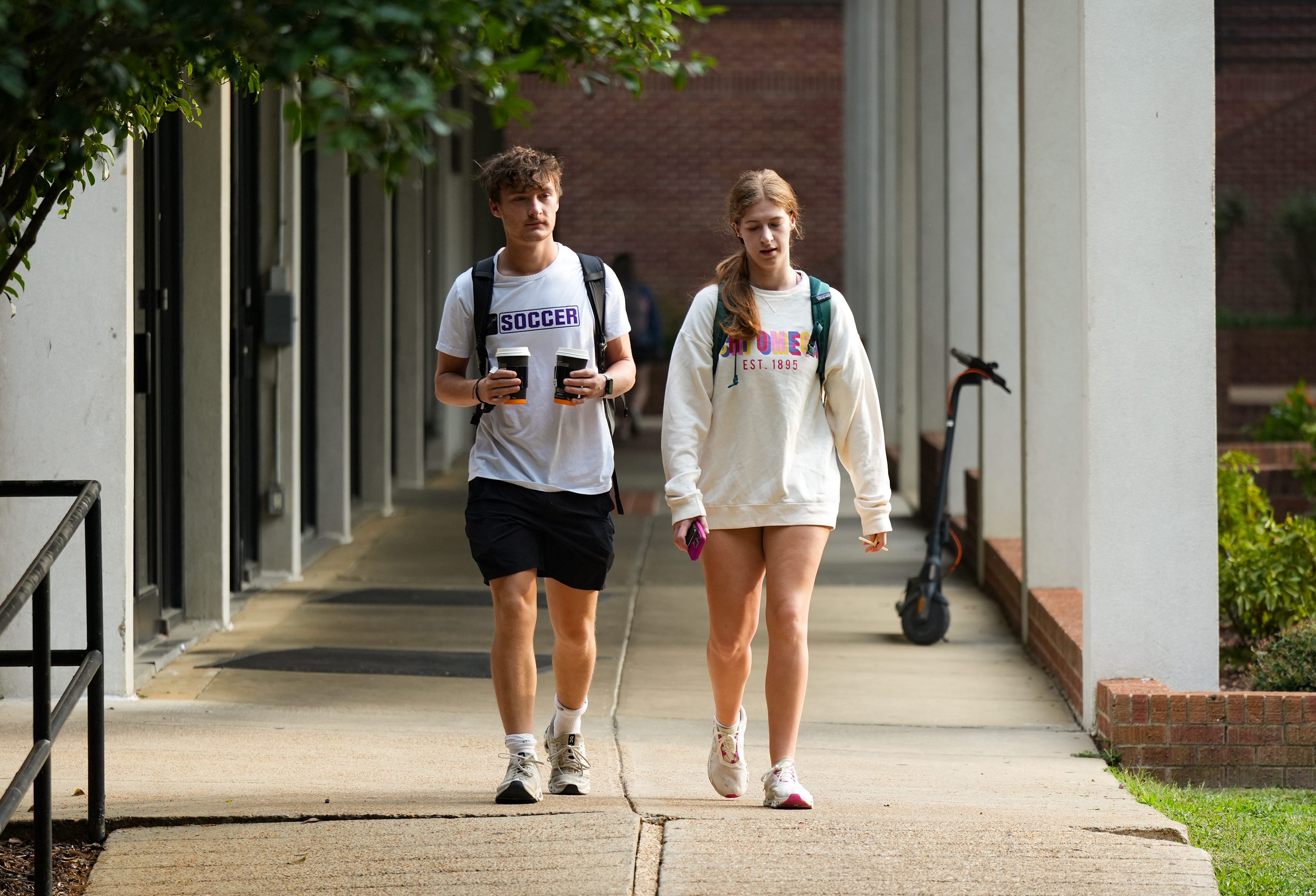

Lane Kirk, 21-year-old senior, and his girlfriend Bailey Johnson, 20-year-old junior, walk across Millsaps College campus in Jackson, Miss., on Monday morning, Sept. 15, 2025.
America’s youngest generation has always carried a reputation for breaking with tradition, but a new NBC News Decision Desk poll suggests that when it comes to questions of marriage and children, Gen Z isn’t just challenging older norms — they’re challenging each other.
Gen Z Can’t Agree on the Definition of Success

Haleigh Karr, a first year teacher at Greenwood Middle School, works with students Tuesday, Sept. 16, 2025, inside her classroom.
The survey found a deep gender divide over what it means to build a successful life. While Gen Z men — particularly those aligned with former President Donald Trump — still see marriage and raising children as central markers of adulthood, Gen Z women, especially those who supported Vice President Kamala Harris in 2024, rank those milestones far lower. The poll is one more indication that political polarization within the generation is bleeding into cultural values, shaping not only how young Americans vote, but how they imagine their futures.
Gen Z Men Want To Start Families

John Bonene, owner of Bonene Enterprise Inc. is one of many voters who switched from voting for President Biden to voting for Donald Trump in this past election. Bonene was inside Athena’s Diner in Lansing on Saturday, Dec. 14, 2024 cleaning their carpets.
The differences were stark. For Trump-voting Gen Z men, having children ranked first on their definition of success. Marriage came in fourth. Among Harris-voting Gen Z women, by contrast, children fell near the bottom, ranked as the second least important factor, and marriage was relegated to eleventh place. Even among Trump-supporting Gen Z women, marriage and kids were valued far less, coming in ninth and sixth, respectively.
A Generation Divided

College students drink some beer as they get ready for the Louisville-James Madison college football game Friday September 5, 2025 at L&N Credit Union Stadium in Louisville, Kentucky.
The results are layered, but one thing is clear: even within a generation stereotyped as progressive and restless, gender is emerging as one of the sharpest dividing lines. John Della Volpe, director of polling at Harvard’s Institute of Politics, says that the data shows how “Gen Z is not just divided by party but by what they consider a meaningful life—for many men, that still includes traditional milestones, while for many women, it’s increasingly about independence and personal choice.”
The Loneliest Generation

A lone student wore an anti-DEI support t-shirt that read DEI Didn’t Earn It before a rally to protect DEI in America Friday at the University of Louisville campus in Louisville, Kentucky Feb. 28, 2025
The poll’s findings arrive against the backdrop of two national trends: rising loneliness among young Americans and an ongoing decline in fertility rates. A December study from consumer research firm GWI labeled Gen Z the loneliest generation, with nearly 80 percent saying they felt lonely over the past year. At the same time, the U.S. fertility rate sits at just 1.6 births per woman, well below the 2.1 needed to maintain population levels without immigration.
The Freedom To Be Who You Want To Be

Hunter Brown, 21, and Katie Martinez, 22, grab drinks from the bar at This Is It! before dancing to songs by Charli XCX, Chappell Roan and more Gen Z favorites.
For policymakers and demographers, the gap between values and outcomes is troubling. For young people, it may simply be reality. Gen Z has lived its formative years in the shadow of economic upheaval, a pandemic, and an unstable political climate. That may explain why so many young women, in particular, see success less in terms of family and more in terms of freedom — the freedom to define adulthood on their own terms.



