
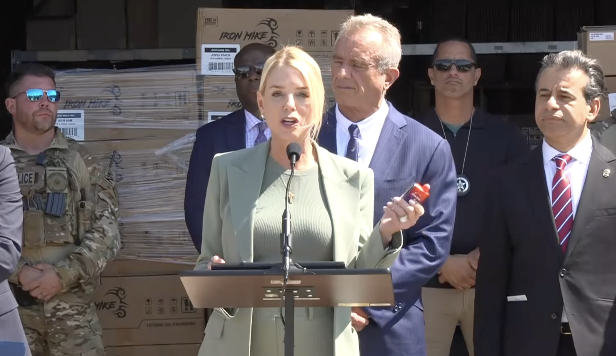
In Chicago’s suburbs, federal officials announced a sweeping, coordinated seizure of illicit vaping products, framing it as a public-health and consumer-protection push aimed at keeping unapproved, youth-targeted devices off U.S. shelves.
Attorney General Pam Bondi, joined by Health and Human Services Secretary Robert F. Kennedy Jr., FDA Commissioner Marty Makary, the U.S. Marshals Service, ATF, and the U.S. Attorney for the Northern District of Illinois, said teams executed federal court warrants at distributors and retailers across multiple states. While the largest action took place at a warehouse outside Chicago, simultaneous operations occurred or were underway in North Carolina, New Jersey, Arizona, Georgia, and Florida, following weeks of FDA inspections and ATF controlled buys. Officials said roughly 50 truckloads and more than 1,400 pallets of product were seized from warehouses and stores, much of it described as flavored, brightly packaged, and marketed with names like “pina colada,” “watermelon ice,” “cotton candy,” or video-game themes.
The core allegation: many devices were imported outside proper channels, lacked FDA authorization, and failed labeling and safety requirements. Bondi and Kennedy stressed that these products often contain undisclosed or untested chemicals, extreme nicotine levels, and sometimes THC; some, they added, were being sold near schools and military bases. Bondi cited reports of adolescent hospitalizations for vaping-related lung issues and warned that a single disposable device can deliver nicotine comparable to a pack of cigarettes. Officials said today’s actions focused on civil seizures; potential criminal charges could follow as investigations progress.
Kennedy linked the scope of the problem to market “availability,” asserting that about 9,000 e-cigarette brands are being sold domestically and only 27% have FDA authorization. He also criticized “port shopping”—where refused shipments are re-routed to other U.S. ports—and said that loophole is being closed. ATF leaders highlighted their authority under the PACT Act to inspect sellers and follow the flow of proceeds, which they said can reach foreign adversaries, cartels, and domestic criminal networks.
FDA’s Makary called the day’s seizures the largest in the agency’s history and compared the need for early action to lessons from the opioid crisis: stop addiction before it starts. HHS described an “all-of-the-above” approach—tightening enforcement, funding research to understand youth vaping at scale, boosting parent and school education, and coordinating with DOJ to disrupt distribution.
Officials emphasized that flavored, youth-oriented products are illegal if not FDA-authorized, and urged parents to check local shops and packaging. Retailers were given what Bondi called a “final warning”: remove unauthorized products or face further enforcement. The message, they said, is simple—unapproved, kid-targeted vapes won’t be allowed to remain on U.S. shelves.
Source: The U.S. Department of Justice



