
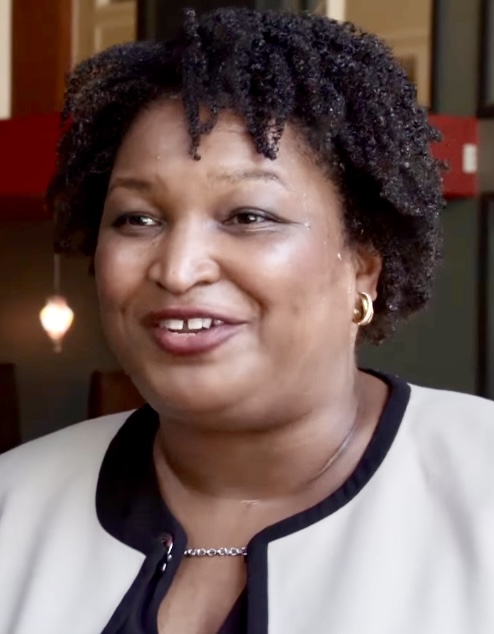
Stacey Abrams has a blunt message for Americans worried about the country’s direction: reclaim patriotism, call out cowardice, and show up. In a wide-ranging appearance on the “Best People” podcast, the former Georgia House minority leader sketched a civic road map she says can counter what she calls a well-worn, 10-step playbook toward autocracy.
“We have to reclaim the patriotism that we all say spurs us. We have to call the cowards what they are, and we have to defeat them at their own game by showing up despite what they try to do to stop us,” Abrams said, arguing that democratic backsliding succeeds when people surrender to despair.
Abrams framed today’s politics as a clash between “recognized power” and real capacity. She said, “We are in a minority position in terms of recognized political power. But we are not in the minority in terms of capacity.”
She described a familiar pattern she says repeats in countries that drift toward strongman rule: stretching executive authority, weakening competing institutions, gutting government’s ability to deliver services, installing loyalists, attacking independent media, scapegoating vulnerable communities, targeting civil society, normalizing private violence, and finally, manipulating elections. “If people can’t vote, democracy can’t work,” she said, warning that aggressive gerrymanders and voting restrictions function as “the gateway drug to ending democracy.”
Georgia, in Abrams’ telling, is the case study—both for suppression and for how organizing can answer it. She criticized the post-2020 celebration of state officials who refused to overturn results, even as those same leaders advanced new voting limits.
Abrams pressed Democrats and pro-democracy voters to move past arguments about convincing hardened partisans and instead engage the tens of millions who sat out recent elections. “I’m focused on the 90 million who did not believe their voices matter,” she said. Winning, she added, is cumulative, not cinematic. “Progress counts as victory… If we have to wait for a large announcement like elections to say that this is when we win, we’re going to keep losing.”
Her prescriptions were concrete and local. She urged people to attend city council, county commission, and state legislative meetings as budgets tighten, to demand spending that protects communities instead of chasing distractions. She encouraged “stackable” habits—weekly service at food pantries or school backpack programs, for instance—because institutions “scale what individuals do.” And she argued for affirmative national reforms such as automatic and same-day voter registration rather than piecemeal repairs to restrictive laws.
Abrams also rejected crime-centric rhetoric she said is designed to justify deployments of force rather than solve problems. “This isn’t about crime… He cares about power. He cares about scaring you,” she said of efforts to put troops on city streets. The point, she argued, is to keep public attention on power grabs, not their justifications.
The through line was insistently practical: tell the truth, organize where you live, and make small gains that accumulate into structural change. “We can’t win by pretending that the pain isn’t real,” Abrams said. “We win by offering aid… and by believing we are entitled to better—and working for it.”



