
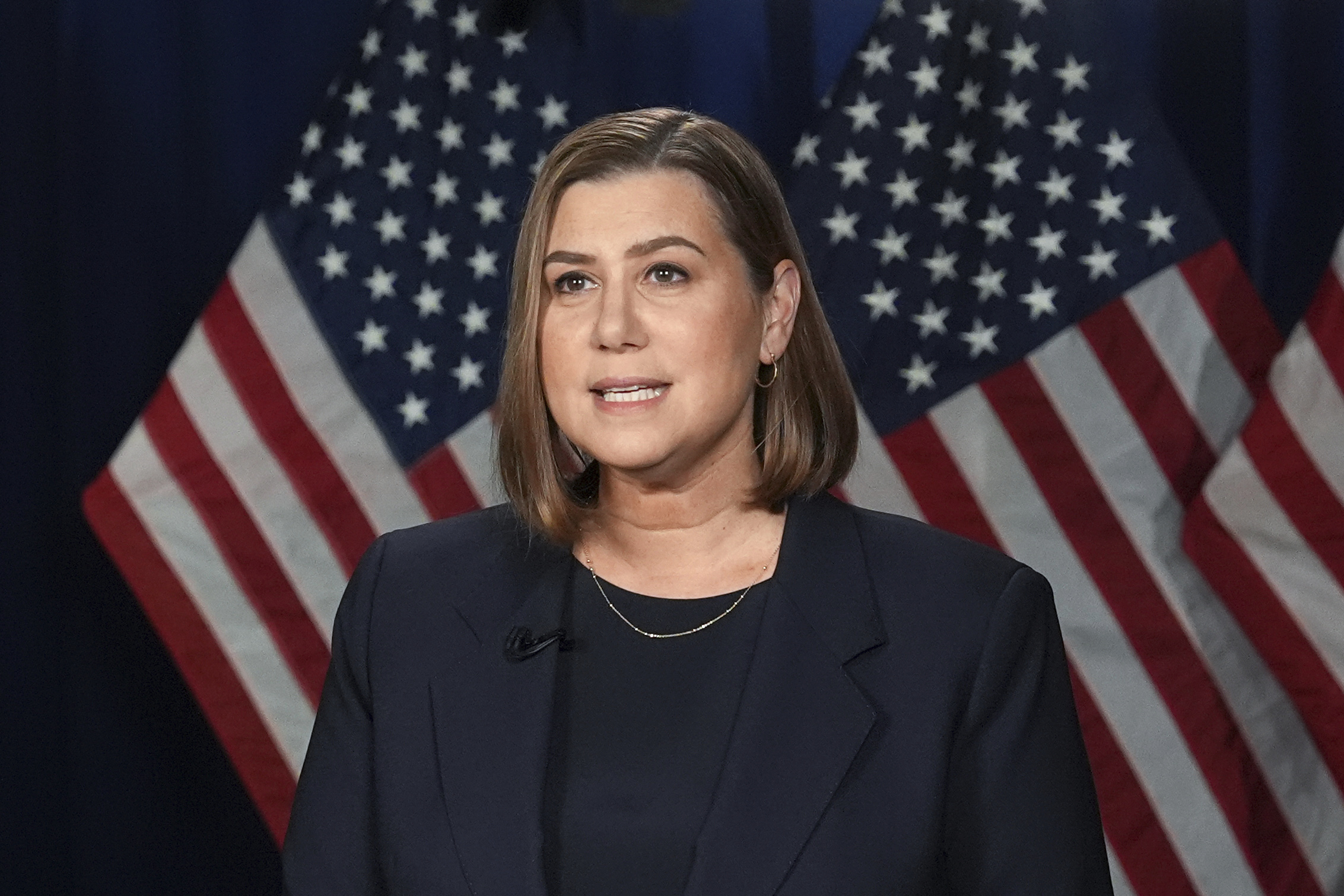
Senator Elissa Slotkin of Michigan is trying to get Americans to think about national security differently. Not in terms of far-off wars or rival powers, but in terms of middle-class families, their jobs, and whether they feel stable enough to build a future.
Speaking Friday at the Council on Foreign Relations in New York, Slotkin laid out what she described as a plan that could “define American security for the next 50 years.” Her central argument was simple: the most serious threat facing the country isn’t coming from abroad, but from within — from a middle class that has shrunk dramatically over the past half-century.
“A national security strategy worth its salt must do two things,” Slotkin said. “Protect U.S. citizens, the homeland, and our way of life. And second, advance American prosperity.” She cited data showing the share of Americans in the middle class has fallen by nearly 20 percent in the last 50 years. That loss of economic stability, she argued, feeds frustration and political volatility. “They feel angry. They lose their dignity, they feel shame, and they start looking for someone or something to blame. That’s how we begin to tear each other apart from the inside.”
To restore that sense of security, Slotkin outlined a sweeping set of priorities. First, she argued that the U.S. must guard its economic position, keeping the dollar the dominant global currency and ensuring access to affordable credit and goods. She called for treating supply chains for critical products — from pharmaceuticals to semiconductors — as national security assets, and even proposed stockpiling rare earth minerals, similar to how the country created the Strategic Petroleum Reserve in the 1970s.
But economic stability, in Slotkin’s telling, is only part of the equation. The second pillar of her plan is technology, and particularly artificial intelligence. After touring Los Alamos National Lab, where a new AI research center is being planned in partnership with the University of Michigan, Slotkin said she left convinced that AI poses questions as profound as those raised by nuclear weapons in the last century. “How should they be used? By whom? Under what rules? Only this time we are creating a technology that can become smarter than the humans who are designing it.”
To keep pace, she argued, the U.S. must rethink its defense industry. Instead of slow, costly projects designed for narrow threats, she urged a pivot to adapting commercial technologies for military use. “We literally need to take a battle ax to the old way of doing business,” Slotkin said.
Finally, Slotkin focused on the homeland. In her view, cyberattacks on American infrastructure and individuals are no less serious than traditional military strikes. She floated the idea of a Cyber National Guard to prevent or respond to such incidents, and called for stronger tools for the FBI and Defense Department to pursue attackers. “We need a new vision of homeland security,” she said, “updated from my era of 9/11 with new playbooks, new authorities, and new capabilities to protect Americans from digital warfare.”
For Slotkin, the point is not just to respond to today’s threats but to build a foundation for the next half-century.



