
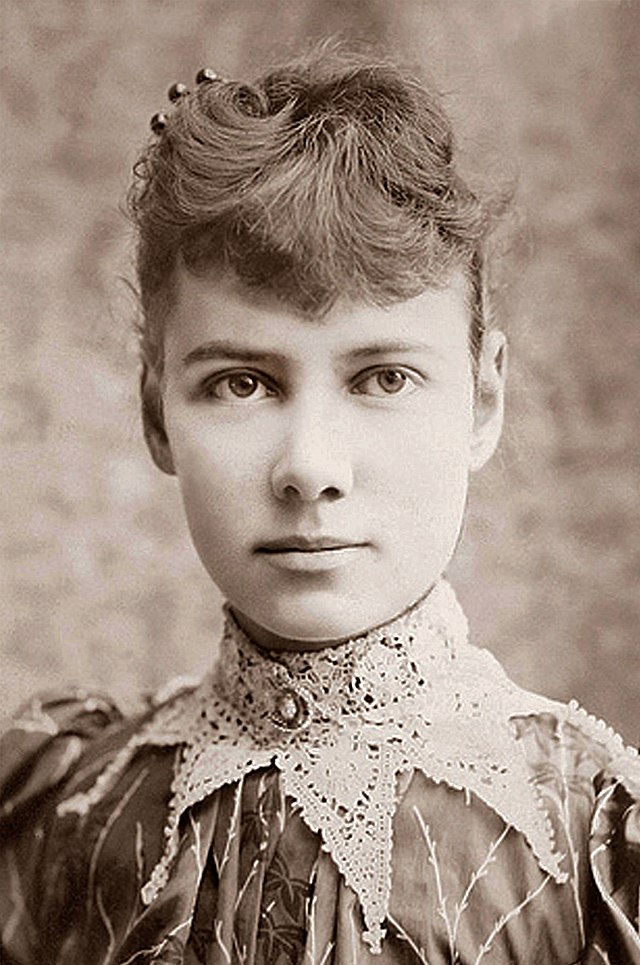
Elizabeth Cochrane Seaman lived a life that defied expectations. Better known by her pen name Nellie Bly, she was one of the most daring and innovative journalists of her era, a woman who pushed past the limits society set for her and left behind a record of work that still feels startling in its courage. Her name is usually linked to two extraordinary feats: the 72-day trip around the world that captivated readers in 1889, and her searing exposé of the New York City Lunatic Asylum on Blackwell’s Island. But the arc of her career tells a much broader story—one about resilience, about invention, and about a relentless drive to change the world she lived in.
Born in Pennsylvania in 1864, Bly started in the humblest corner of journalism. At just 16, she was writing what were called “women’s columns” for the Pittsburgh Dispatch, pieces about home, hearth, and child-rearing. She wasn’t satisfied with that lane for long. She convinced her editors to let her take on harder subjects, writing about divorce and women’s rights, and soon she was restless again. In her early twenties, she left Pittsburgh behind, scribbling a short note for her editors: “I am off for New York. Look out for me.”
In New York she quickly found a foothold at Joseph Pulitzer’s World. Her first assignment there is the stuff of legend: could she get herself committed to an asylum in order to report, firsthand, what life inside was really like? The fact that she accepted without hesitation already tells you something about her. Getting herself committed turned out to be easy. Getting out was another matter.
Her series, published in October 1887 and later collected in the book Ten Days in a Mad-House, laid bare the neglect, abuse, and cruelty that patients—many of them not truly mentally ill at all—endured on Blackwell’s Island. She described women left in filth, doctors who barely paid attention to them, patients forced into freezing baths or locked into vermin-infested rooms, immigrants whose lack of English was mistaken for madness. The public was horrified. The city had no choice but to respond. A million dollars a year was added to the asylum budget. A grand jury investigated. Conditions improved. It was, by any measure, a triumph of investigative journalism.
Bly didn’t stop there. Just two years later, she boarded a steamer and set off on a whirlwind attempt to outdo Jules Verne’s fictional Phileas Fogg and travel around the world in less than 80 days. She did it in 72. At a time when women rarely traveled without chaperones, Bly crossed continents and oceans alone, filing dispatches that enthralled readers and made her an international sensation.
Her later years were just as full of twists. In 1895 she married Robert Seaman, a wealthy industrialist decades older than she was, and stepped into a new role as head of his Iron Clad Manufacturing Company after his health declined. She wasn’t a natural with the financial side of things, and eventually the company went bankrupt, but she left her mark there too, securing patents for improved milk cans and garbage cans and briefly becoming one of the country’s leading female industrialists.
When she returned to reporting, she did so with the same verve as before—covering suffrage parades, writing boldly that women were “men’s superiors,” and traveling to the Eastern Front during World War I, where she was even arrested on suspicion of being a British spy.
She died in 1922 at just 57 years old, from pneumonia. It’s impossible not to wonder what more she might have done had she lived longer. Even so, her impact is unmistakable. She forced the city of New York to reckon with its treatment of the mentally ill. She showed readers—and especially women—what ambition and courage could accomplish. And she helped expand the possibilities of journalism itself, showing it could be both a mirror of society and a lever to change it.
Nellie Bly was more than a reporter with a flair for stunts. She was a pioneer whose work revealed truths others wanted to keep hidden, and whose legacy is still felt every time journalism is used to shine light in the darkest corners.



