
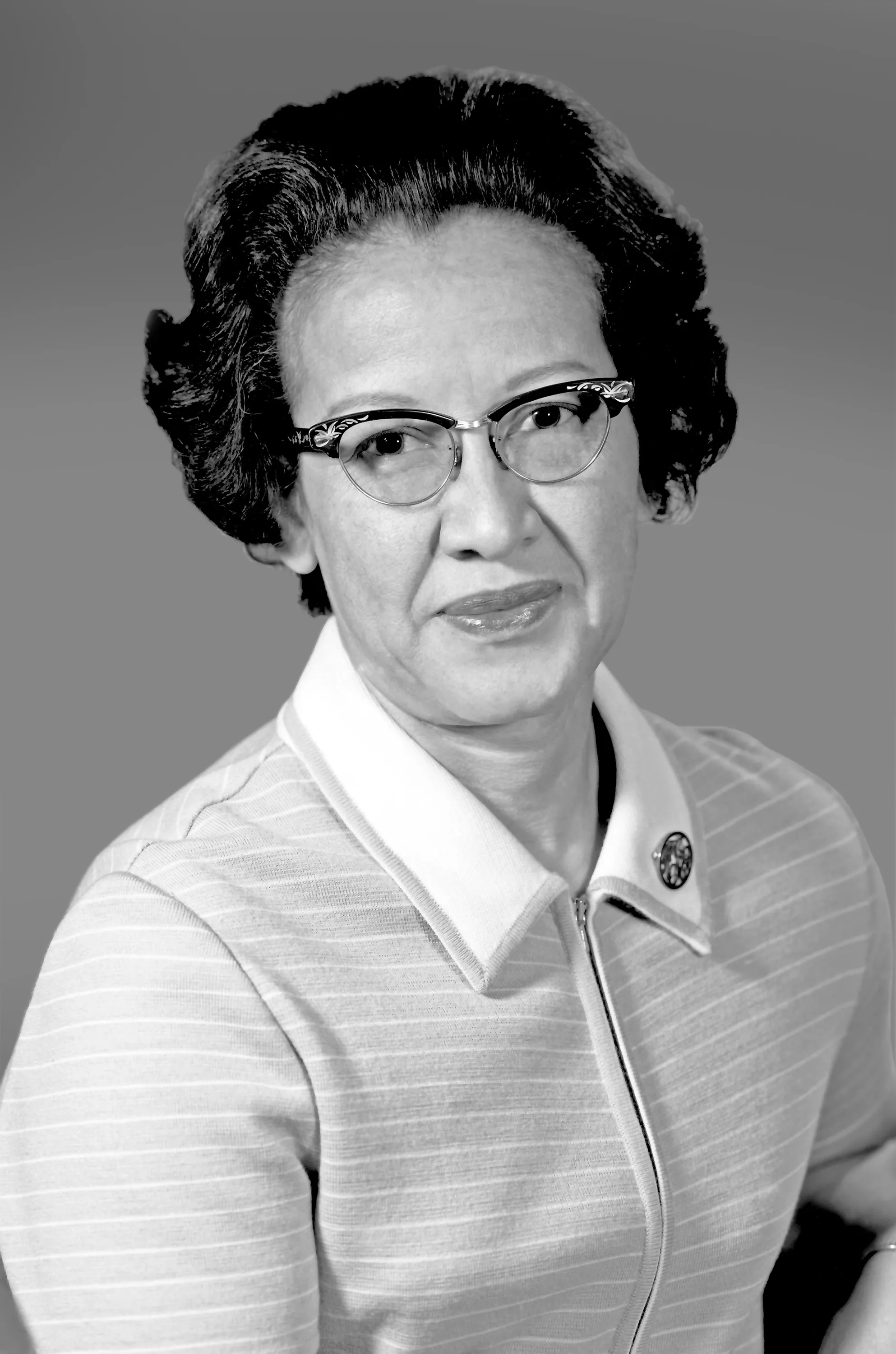
For most people, being chosen as one of three Black students to integrate West Virginia’s graduate schools would be the defining chapter of a life story. For Katherine Johnson, it was just the opening act in a career that reshaped America’s reach into the heavens.
Born in White Sulphur Springs, West Virginia, in 1918, Johnson’s knack for numbers was evident early. By 13, she was already in high school, and by 18 she had enrolled at West Virginia State College, mentored by W.W. Schieffelin Claytor, only the third African American to earn a Ph.D. in mathematics. She graduated with highest honors in 1937 and began teaching, but mathematics kept pulling her forward.
When West Virginia quietly integrated its graduate schools in 1939, Johnson was handpicked to enroll. She began graduate work in mathematics but left after one session to start a family. Years later, after raising three daughters, she returned to teaching before finding her way to a new opportunity: the West Area Computing section of the National Advisory Committee for Aeronautics (NACA), the forerunner to NASA.
Johnson started at Langley Research Center in 1953. Her first assignments involved flight tests and turbulence analysis. But when the Soviet Union launched Sputnik in 1957, her career—and the nation’s priorities—shifted. She joined the Space Task Group, providing trajectory analysis for Alan Shepard’s 1961 Freedom 7 mission, America’s first human spaceflight.
Her most famous contribution came in 1962, ahead of John Glenn’s Friendship 7 orbital mission. Glenn, uneasy about trusting computers with his life, asked engineers to “get the girl” to check the math by hand. Johnson ran the equations, confirmed the trajectory, and Glenn went on to become the first American to orbit the Earth. “If she says they’re good, then I’m ready to go,” Glenn had said.
Johnson’s work extended far beyond Glenn’s flight. She calculated rendezvous paths for Apollo’s Lunar Module, contributed to the early Space Shuttle program, and worked on satellite projects that transformed Earth observation. Over a 33-year career, she authored or coauthored 26 research reports and became known simply as a “human computer.”
She retired in 1986 but remained an icon of perseverance and brilliance. In 2015, President Barack Obama awarded her the Presidential Medal of Freedom, the nation’s highest civilian honor. NASA later named two facilities after her, including the Katherine G. Johnson Computational Research Facility at Langley.
Johnson died in 2020 at the age of 101. At her passing, NASA Administrator James Bridenstine called her “an American hero” whose “pioneering legacy will never be forgotten.” For every American astronaut who looked back at Earth from orbit, Johnson’s equations lit the path home.



