
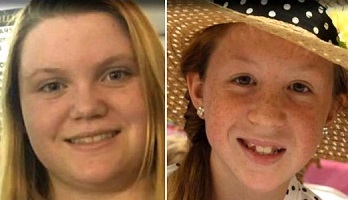
The murder of 13-year-old Abby Williams and 14-year-old Libby German in Delphi, Indiana, has haunted the small Carroll County town for more than eight years. Now, in a new three-part documentary, Capturing Their Killer: The Girls on the High Bridge, the case is examined through the voices of family members, investigators, and—speaking publicly for the first time—the wife of the man convicted of the killings.
Kathy Allen’s marriage to Richard Allen spanned decades. High school sweethearts who wed young, they built a life together, raising a daughter and eventually settling in Delphi, where Richard worked at the local CVS. On February 13, 2017, while Kathy was at work, Richard had the day off. That evening, the news broke that two local girls were missing after hiking near the Monon High Bridge. It only took a day to find the bodies of Abby and Libby, but by then it was too late.
The deaths of these two girls threw Delphia, Indiana into a panic. Who would, who could, do this sort of thing? The only information available to the public was a grainy image found on Libby’s phone that showed a man walking towards her and her friend. Then, a short audio clip featuring the man’s voice telling them to go “down the hill.” The suspect became known only as “bridge guy.”
Richard Allen had told his wife that he was on the trail that day but claimed not to have seen the girls. He even contacted police to offer help. For more than five years, the investigation continued with no arrest—until a volunteer file clerk in September 2022 uncovered a misfiled report in which “Richard Allen Whiteman” had self-reported being at the scene the day of the murders. Allen lived on Whiteman Drive, and investigators concluded the names had been transposed.
Weeks later, police searched the Allens’ home. On Halloween 2022, they announced Richard Allen’s arrest. At trial, prosecutors presented a key piece of physical evidence: an unspent .40-caliber round found near the bodies, which they said had been cycled through Allen’s Sig Sauer pistol. They also introduced multiple confessions Allen made to his wife, corrections officers, and a psychologist while in jail, including one call where he told Kathy, “I did it. I killed Abby and Libby.”
Kathy Allen insists those statements came during a period when her husband’s mental health was collapsing in solitary confinement. “My husband’s not a monster,” she said. “He’s not the monster that people think he is.” The defense argued that his psychotic state made the confessions unreliable, but jurors found him guilty in November 2024 on four counts of murder and felony murder.
At sentencing, Judge Fran Gull called the killings among “the most heinous crimes in the state of Indiana.” Prosecutor Nicholas McLeland credited Libby’s presence of mind in recording “bridge guy” and Abby’s decision to hide the phone as critical to solving the case.
For the victims’ families, the verdict brought relief but not closure. “You think hearing ‘guilty’ is gonna be enough,” said Abby’s mother, Anna Williams. “And it’s just not true. This doesn’t bring her back. The girls are still gone.”
Kathy Allen says she is hopeful for an appeal. “It was definitely our dream to grow old together, and it still is. I’m not giving up,” she said. But for Delphi, the murders remain a deep wound—one that no verdict can heal.



