
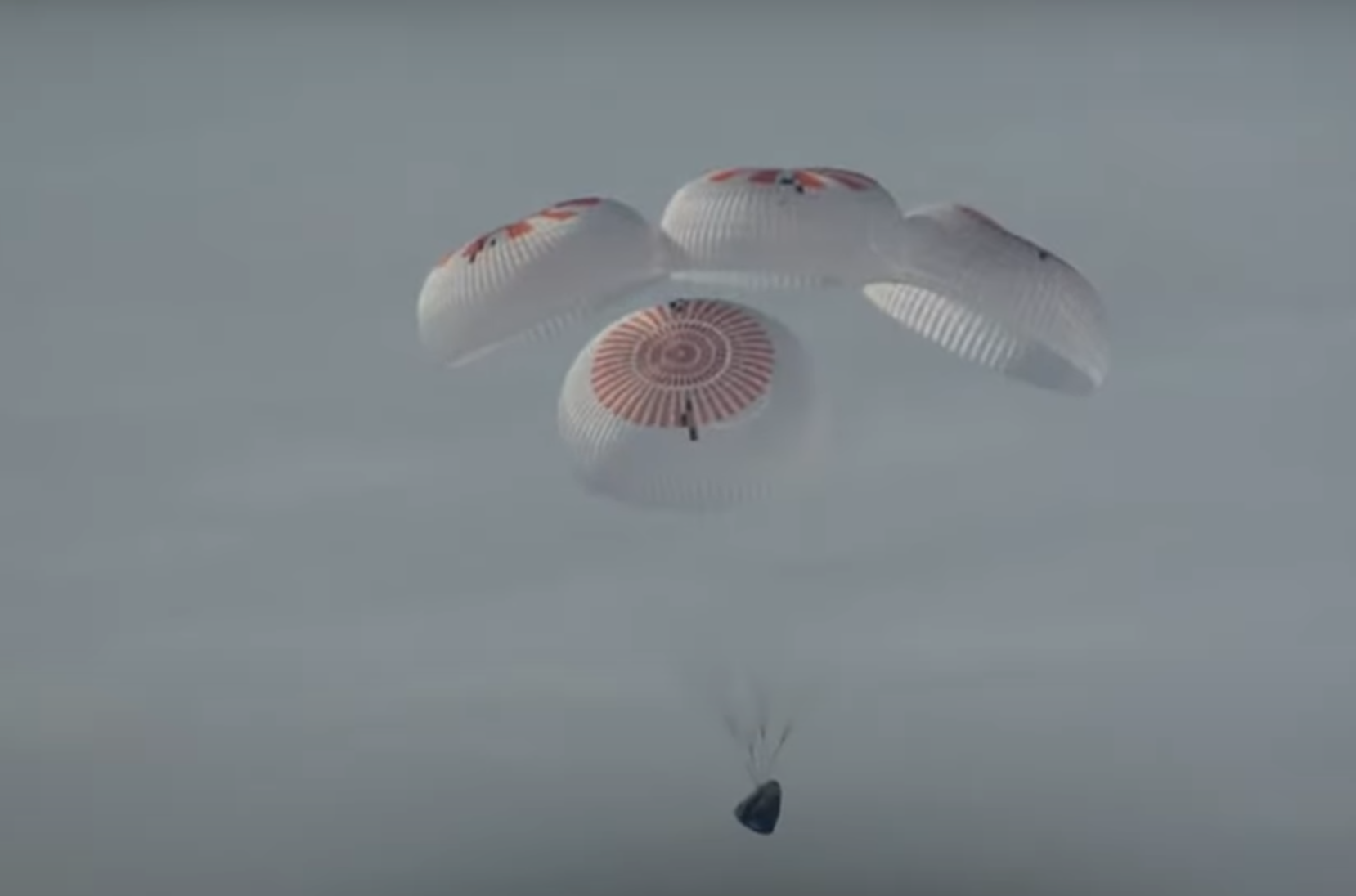
SpaceX’s Crew-10 astronauts returned safely to Earth on Saturday, splashing down in the Pacific Ocean off California after nearly five months aboard the International Space Station (ISS).
The mission’s Crew Dragon capsule, Endurance, landed at 11:33 a.m. EDT, marking the first time a NASA Commercial Crew Program flight has concluded in Pacific waters. Recovery teams quickly retrieved the capsule and its crew — NASA astronauts Anne McClain and Nichole Ayers, JAXA’s Takuya Onishi, and Roscosmos cosmonaut Kirill Peskov — before flying them to NASA’s Johnson Space Center in Houston for reunions with family.
“From the entire Crew-10, thank you,” McClain radioed moments after splashdown. “It was truly the ride of a lifetime.”
Launched on March 14 from Kennedy Space Center in Florida, Crew-10 arrived at the ISS two days later. Over the course of 148 days in orbit, the astronauts logged more than 62 million miles and completed 2,368 orbits of Earth. Their work supported hundreds of hours of scientific research, station maintenance, and technology demonstrations.
NASA said their experiments ranged from studying microalgae growth and DNA damage from space radiation to tracking how microgravity affects human eye structure and cardiovascular function. The crew also tested future lunar navigation techniques and examined blood flow changes from the brain to the heart — research that could inform long-duration missions to the Moon and Mars.
McClain and Ayers ventured outside the station on May 1 for a spacewalk, relocating a communications antenna and beginning preparations for a new roll-out solar array. It was McClain’s third spacewalk and Ayers’ first.
The return marked a milestone for NASA and SpaceX. Until now, all operational crewed Dragon missions had landed off Florida’s Atlantic or Gulf coasts. SpaceX recently shifted to West Coast recoveries for all Dragon spacecraft, citing safety concerns about falling debris over populated areas.
The flight was the first space mission for Ayers and Peskov, and the second for McClain and Onishi. With Crew-10, McClain has now logged 352 days in space, while Onishi has spent 263 days in orbit across his two flights. Onishi served as ISS commander from April until last week, when he handed over to cosmonaut Sergey Ryzhikov.
Their return followed the arrival of Crew-11 on Aug. 2, ensuring continuous staffing aboard the station.
“Crew missions are the building blocks for long-duration, human exploration,” NASA acting administrator Sean Duffy said. “They push the boundaries of what’s possible and lay the groundwork for a thriving space industry — from private space stations in low Earth orbit to human exploration of the Moon and Mars.”
For the Crew-10 astronauts, the journey home was both an ending and a beginning — the close of a shared chapter in orbit, and a step toward the next era of human spaceflight.



