
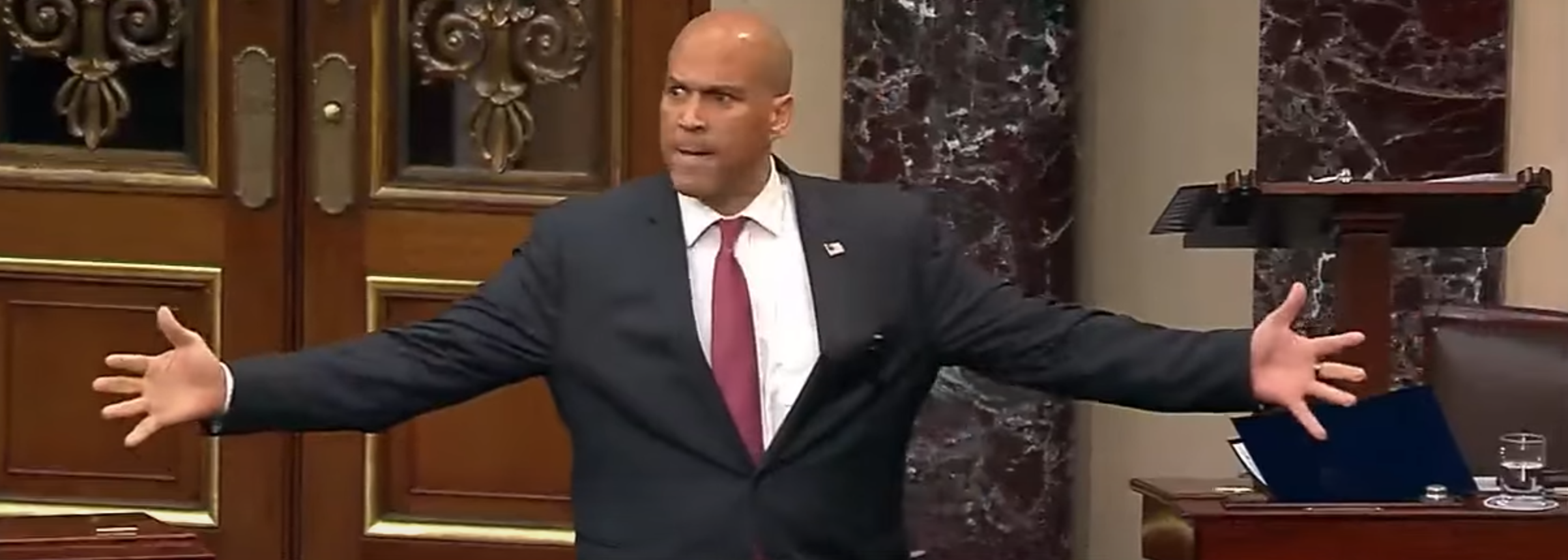
A rare and fiery intra-party clash broke out on the Senate floor Tuesday, as Democratic Senators Cory Booker and Amy Klobuchar publicly sparred over a package of bipartisan police funding bills—and over how their party should confront Donald Trump’s return to power.
The confrontation began when Sen. Catherine Cortez Masto (D-NV) moved for unanimous consent to pass a series of law enforcement bills as part of “Police Week.” But Sen. Booker (D-NJ) objected, offering an amendment that would increase grant access for New Jersey—and using the moment to deliver a broader rebuke of his party.
“When are we going to stand together?” Booker asked. “That is complicity with an authoritarian leader who is trashing our Constitution.” He accused the party of begging for scraps and warned that without a stronger, unified opposition to Trump, Democrats “deserve to lose.”
Klobuchar (D-MN) responded sharply. She criticized Booker for missing prior committee markups where he could have raised concerns, saying, “I like to show up at the markups and make my case.” She defended the bills—many of which passed out of committee unanimously—as critical support for police departments nationwide, including mental health services, recruitment aid, and support for families of fallen officers.
Booker, visibly emotional, shot back: “Don’t question my integrity. Don’t question my motives.” He recounted personal connections to law enforcement and his own work on bipartisan police reform, including legislation he helped pass with Sen. Chuck Grassley.
But the New Jersey senator warned that police funding decisions should not be made blindly under the shadow of a president he described as “trashing the Constitution” and rewarding states based on loyalty. “If we don’t stand up as Democrats, we deserve to lose,” Booker said. “It’s time for Democrats to have a backbone. It’s time for us to fight.”
Though he eventually withdrew his objection and allowed the bills to pass, the moment laid bare a growing tension within the Democratic Party: how to govern under a resurgent Trump presidency without appearing to normalize it—and whether to draw harder lines in the sand.
Klobuchar acknowledged Trump’s transgressions but defended the legislation’s urgency: “I completely agree with Senator Booker about what this administration is doing. But you can’t just pick out a few bills that came out of a committee and say, ‘I’m going to stop those.’”
It’s clear that, even – or especially – among Democrats, unity is far from guaranteed in the high-stakes months ahead. As Trump continues to reshape the federal government, Booker’s warning may resonate: “The Democratic Party needs a wake-up call.”



