
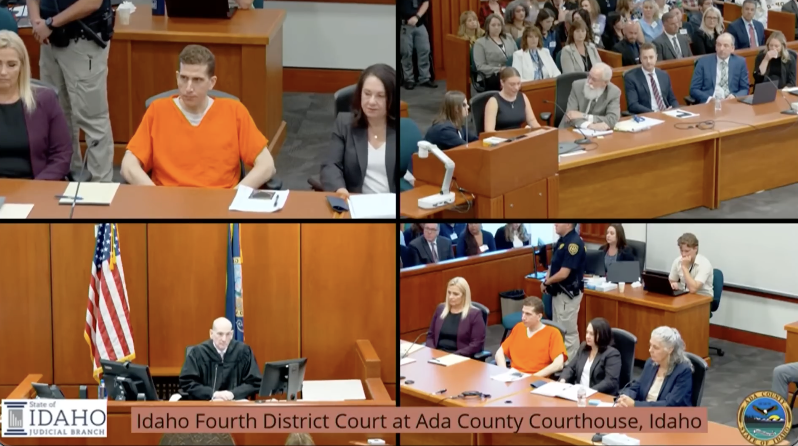
When Dylan Mortensen stood to speak at the sentencing of Bryan Kohberger—the man who brutally murdered four of her closest friends in November 2022—her voice shook, but her resolve was clear.
“I get to live,” she said. “And while I will still live with this pain, at least I get to live my life. He will stay here, empty, forgotten, and powerless.”
Mortensen, one of two surviving roommates in the University of Idaho house where Kohberger killed Kaylee Goncalves, Madison Mogen, Xana Kernodle, and Ethan Chapin, delivered a devastating victim impact statement that gave voice to both the unspeakable trauma of surviving and the fierce love she still holds for her lost friends.
And speak she did—with aching honesty, profound grief, and undeniable courage.
Throughout her statement, Mortensen shifted between quiet pain and soaring emotion, recounting not just the horror of what happened that night, but the ripple effect it caused in every part of her life. She spoke of her friends as light: people who made every room feel safe, joyful, and full of love.
“He took away the ability for me to tell them that I love them,” she said. “He took away birthdays, graduations, celebrations… all of it is gone.”
For so long, Mortensen was largely silent in public accounts of the tragedy. Whispers and speculation about her experience circulated on social media. But in this moment, she reclaimed her narrative—not as a passive survivor, but as a young woman who had endured unimaginable loss and was choosing to speak.
The emotional toll Mortensen described was raw and visceral. After the murders, she said she couldn’t sleep alone and became consumed with fear. She mapped escape plans for every room she entered. Her body, she explained, was locked in a cycle of reliving the trauma—panic attacks striking “like a tsunami,” leaving her unable to breathe or think.
“It’s far beyond anxiety,” she said. “It’s my body reliving everything over and over again. My nervous system never got the message that it is over.”
Though praised by some as brave and resilient, Mortensen pulled back the curtain on what that survival has looked like: hypervigilance, exhaustion, grief, and a loss of safety so profound it fractured her sense of self.
“People call me strong,” she said, “but they don’t see what my new reality looks like.”
In perhaps the most powerful moment of her statement, Mortensen rejected Kohberger’s ability to take away the core of who she is. Yes, he shattered her. Yes, he stole the version of her that felt safe in the world. But he did not—and will not—take her voice.
Again and again, Mortensen returned to the memory of her friends—not as victims, but as people who loved and were loved. She recalled a dream in which she said goodbye to them, a dream she described as heartbreaking yet strangely comforting. It offered a kind of closure she’d never had.
“No dream can replace them,” she said. “And no goodbye will ever feel finished.”
Ultimately, Mortensen’s testimony was not about Kohberger—it was about her friends, and the life she still carries on their behalf. While speaking about her recovery, Mortensen never described it as something she did on her own, but as a way to heal with the memory of her friends.
In a courtroom where grief spilled over into rage, forgiveness, and silence, Mortensen’s words stood out for their clarity and power. She didn’t need to analyze motive or make sense of the senseless. Her words were her justice. She named what Kohberger took from her, and she named what remained: love, memory, resilience.
And in doing so, she reminded all of us—especially women, especially survivors—that telling your story can be the most potent form of resistance.
“He took their lives,” she said. “But I will continue trying to be like them, to make them proud. Living is how I honor them.”
If you or someone you know is struggling with trauma or grief, support is available. Call or text 988 to reach the Suicide & Crisis Lifeline, or visit 988lifeline.org.



