
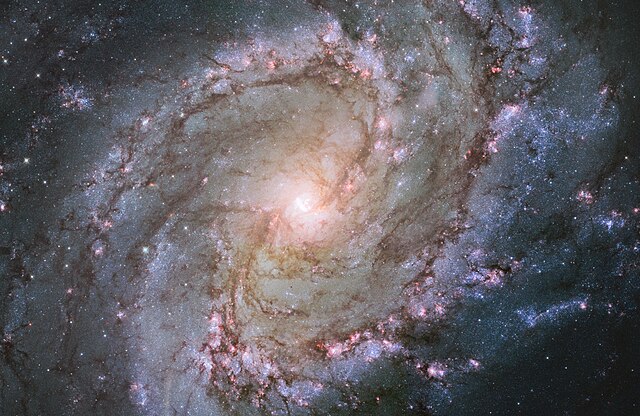
Southern Pinwheel Galaxy

This stunning Hubble image captures the spiral galaxy Messier 83, also known as the Southern Pinwheel Galaxy. A cosmic masterpiece of bright stars and thick dust, it is one of the largest and closest barred spiral galaxies to Earth. Renowned for its dramatic nature, Messier 83 has hosted numerous supernova explosions and harbors a mysterious double nucleus at its core. This celestial wonder continues to intrigue astronomers with its beauty and enigmatic features.
Keyhole Nebula

The Keyhole Nebula, located within the larger NGC 3372 (Carina Nebula), is a stunning region of cosmic activity. Captured in a mosaic of four images taken in April 1999 by Hubble’s Wide Field Planetary Camera 2, this breathtaking formation features dense clouds of gas and dust sculpted by intense stellar winds and radiation. The intricate details of the nebula showcase the dynamic processes of star formation and destruction, offering a glimpse into the universe’s ongoing evolution.
Star Cluster Westerlund 2

The star cluster Westerlund 2, nestled in the Milky Way galaxy, is a vibrant collection of some of the hottest, brightest, and most massive stars known. Estimated to be just one to two million years old, this youthful cluster resides in Gum 29, a stellar nursery located 20,000 light-years away in the constellation Carina. Westerlund 2’s dynamic environment offers astronomers a fascinating glimpse into the processes of star formation and the universe’s early evolution.
Tarantula Nebula

This breathtaking Hubble Space Telescope image showcases R136, a super star cluster located near the center of the 30 Doradus Nebula, also known as the Tarantula Nebula or NGC 2070. This celestial marvel, filled with some of the most massive and luminous stars known, lies 170,000 light-years away in the Large Magellanic Cloud. The cluster’s intense radiation and stellar winds sculpt its surroundings, making R136 a key site for studying star formation and evolution.
Orion Nebula

NASA/ESA’s Hubble Space Telescope captured one of the most detailed images of the Orion Nebula, offering an unprecedented view of this stellar nursery. This extensive study required 105 Hubble orbits, with all imaging instruments working simultaneously to observe the nebula’s intricate structure. The resulting Advanced Camera mosaic spans an area roughly the size of the full moon, showcasing the nebula’s vibrant gas clouds and young stars, making it a cornerstone of astronomical exploration.
Butterfly Nebula

NASA’s Hubble Space Telescope, using the Wide Field Camera 3 (WFC3), captured a stunning image of NGC 6302, the Butterfly Nebula. Located 3,800 light-years away in the constellation Scorpius, this planetary nebula features “wings” of glowing gas expelled from a dying star over 2,200 years. The nebula spans over two light-years, with its shape sculpted by stellar winds and dense dust. The vibrant colors reveal the gas’s composition, showcasing Hubble’s unmatched observational capabilities.
Crab Nebula

This mosaic image of the Crab Nebula, captured by NASA’s Hubble Space Telescope, reveals the six-light-year-wide remnant of a supernova recorded by Japanese and Chinese astronomers in 1054 CE. The orange filaments are hydrogen-rich remains, while a central neutron star powers the nebula’s eerie blue glow. Spinning 30 times per second, the neutron star emits twin beams of radiation. This image, assembled from 24 exposures, showcases vibrant elements like oxygen, sulfur, and the dramatic aftermath of a stellar explosion.
NGC 1672

NASA’s Hubble Space Telescope captured a stunning view of the barred spiral galaxy NGC 1672, located over 60 million light-years away in the southern constellation Dorado. This image reveals intricate details of star-forming clouds and dark interstellar dust bands, showcasing the dynamic processes shaping the galaxy. Taken in August 2005 with Hubble’s Advanced Camera for Surveys, the observations highlight NGC 1672’s vibrant structure and its role in advancing our understanding of galactic evolution.
NGC 602

Hubble’s Advanced Camera for Surveys captured the stunning interplay of NGC 602 and the surrounding nebula N90 in the Small Magellanic Cloud, a satellite galaxy of the Milky Way. Radiation and shock waves from this young star cluster have cleared lighter gas and dust, triggering new star formation in the nebula’s ridges, known as “elephant trunks.” Spitzer Space Telescope reveals these infant stars in infrared. Spanning 200 light-years, the image also features distant galaxies in the background.
Carina Nebula

In celebration of Hubble’s 17th anniversary, astronomers released a breathtaking panoramic image of the Carina Nebula’s central region. Spanning 50 light-years, this cosmic maelstrom of star birth and death reveals monster stars sculpting the nebula with powerful winds and ultraviolet radiation. The luminous Eta Carinae, nearing a supernova explosion, dominates the scene. Captured in stunning detail, this mosaic showcases the nebula’s vibrant structure and ongoing star formation, offering a glimpse into our galaxy’s stellar genesis.
Large Magellanic Cloud

The Hubble Space Telescope’s Advanced Camera for Surveys captured a stunning mosaic of LHA 120-N 11, or N11, in the Large Magellanic Cloud, a neighboring galaxy. Spanning six arcminutes, this image reveals one of the most active star-forming regions in the nearby universe. Young stars and vibrant gas clouds fill the scene, showcasing the dynamic processes of stellar creation. This broad vista highlights the incredible activity shaping the cosmos in our galactic backyard.



