
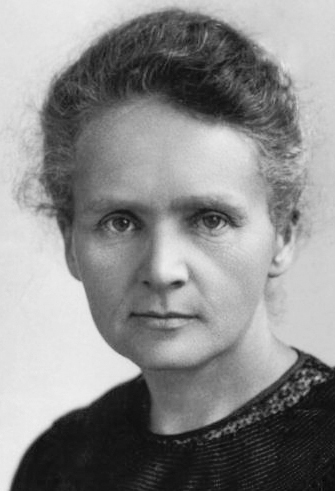
1903 & 1911: Marie Skłodowska-Curie

The Nobel Prize in Physics, 1903: “in recognition of the extraordinary services they have rendered by their joint researches on the radiation phenomena discovered by Professor Henri Becquerel”
The Nobel Prize in Chemistry, 1911: “for her discovery of radium and polonium”
Source: NobelPrize.org
1905: Bertha von Suttner

The Nobel Peace Prize: “for her audacity to oppose the horrors of war”
Source: NobelPrize.org
1909: Selma Lagerlöf

The Nobel Prize in Literature: “in appreciation of the lofty idealism, vivid imagination and spiritual perception that characterize her writings”
Source: NobelPrize.org
1926: Grazia Deledda

The Nobel Prize in Literature: “for her idealistically inspired writings which with plastic clarity picture the life on her native island and with depth and sympathy deal with human problems in general”
Source: NobelPrize.org
1928: Sigrid Undset

The Nobel Prize in Literature: “principally for her powerful descriptions of Northern life during the Middle Ages”
Source: NobelPrize.org
1931: Jane Addams

The Nobel Peace Prize: “for their assiduous effort to revive the ideal of peace and to rekindle the spirit of peace in their own nation and in the whole of mankind”
Source: NobelPrize.org
1935: Irène Joliot-Curie

The Nobel Prize in Chemistry:”for their synthesis of new radioactive elements”
Source: NobelPrize.org
1938: Pearl Buck

The Nobel Prize in Literature: “for her rich and truly epic descriptions of peasant life in China and for her biographical masterpieces”
Source: NobelPrize.org
1945: Gabriela Mistral

The Nobel Prize in Literature: “for her lyric poetry which, inspired by powerful emotions, has made her name a symbol of the idealistic aspirations of the entire Latin American world”
Source: NobelPrize.org
1946: Emily Greene Balch

The Nobel Peace Prize: “for her lifelong work for the cause of peace”
Source: NobelPrize.org
1947: Gerty Radnitz-Cori

The Nobel Prize in Physiology or Medicine: “for their discovery of the course of the catalytic conversion of glycogen”
Source: NobelPrize.org
1963: Maria Göppert Mayer

The Nobel Prize in Physics: “for their discoveries concerning nuclear shell structure”
Source: NobelPrize.org
1964: Dorothy Crowfoot Hodgkin

The Nobel Prize in Chemistry: “for her determinations by X-ray techniques of the structures of important biochemical substances”
Source: NobelPrize.org
Image Credit: CC BY-SA 2.5/University of Bristol
1966: Nelly Sachs

The Nobel Prize in Literature: “for her outstanding lyrical and dramatic writing, which interprets Israel’s destiny with touching strength”
Source: NobelPrize.org
1976: Betty Williams

The Nobel Peace Prize: “for the courageous efforts in founding a movement to put an end to the violent conflict in Northern Ireland”
Source: NobelPrize.org
1976: Mairead Maguire

The Nobel Peace Prize: “for the courageous efforts in founding a movement to put an end to the violent conflict in Northern Ireland”
Source: NobelPrize.org
Image Credit: CC BY-SA 4.0/Nashirul Islam
1977: Rosalyn Yalow

The Nobel Prize in Physiology or Medicine: “for the development of radioimmunoassays of peptide hormones”
Source: NobelPrize.org
1979: Anjezë Gonxhe Bojaxhiu (Mother Teresa)

The Nobel Peace Prize: “for her work for bringing help to suffering humanity”
Source: NobelPrize.org
1982: Alva Myrdal

The Nobel Peace Prize: “for their work for disarmament and nuclear and weapon-free zones”
Source: NobelPrize.org
1983: Barbara McClintock

The Nobel Prize in Physiology or Medicine: “for her discovery of mobile genetic elements”
Source: NobelPrize.org
1986: Rita Levi-Montalcini

The Nobel Prize in Physiology or Medicine: “for their discoveries of growth factors”
Source: NobelPrize.org
1988: Gertrude Belle Elion

The Nobel Prize in Physiology or Medicine: “for their discoveries of important principles for drug treatment”
Source: NobelPrize.org
1991: Nadine Gordimer

The Nobel Prize in Literature: “who through her magnificent epic writing has – in the words of Alfred Nobel – been of very great benefit to humanity”
Source: NobelPrize.org
Image Credit: CC BY-SA 3.0/Vogler
1991: Aung San Suu Kyi

The Nobel Peace Prize: “for her non-violent struggle for democracy and human rights”
Source: NobelPrize.org
1992: Rigoberta Menchú

The Nobel Peace Prize: “in recognition of her work for social justice and ethno-cultural reconciliation based on respect for the rights of indigenous peoples”
Source: NobelPrize.org
1993: Toni Morrison

The Nobel Prize in Literature: “who in novels characterized by visionary force and poetic import, gives life to an essential aspect of American reality”
Source: NobelPrize.org
1995: Christiane Nüsslein-Volhard

The Nobel Prize in Physiology or Medicine: “for their discoveries concerning the genetic control of early embryonic development”
Source: NobelPrize.org
Image Credit: CC BY-SA 2.0 FR/Rama
1996: Wisława Szymborska

The Nobel Prize in Literature: “for poetry that with ironic precision allows the historical and biological context to come to light in fragments of human reality”
Source: NobelPrize.org
Image Credit: CC BY 3.0/Mariusz Kubik
1997: Jody Williams

The Nobel Peace Prize: “for their work for the banning and clearing of anti-personnel mines”
Source: NobelPrize.org
2003: Shirin Ebadi

The Nobel Peace Prize: “for her efforts for democracy and human rights, focusing especially on the struggle for the rights of women and children”
Source: NobelPrize.org
2004: Linda Buck

The Nobel Prize in Physiology or Medicine: “for their discoveries of odorant receptors and the organization of the olfactory system”
Source: NobelPrize.org
Image Credit: CC BY-SA 3.0/The Royal Society
2004: Elfriede Jelinek

The Nobel Prize in Literature: “for her musical flow of voices and counter-voices in novels and plays that with extraordinary linguistic zeal reveal the absurdity of society’s clichés and their subjugating power”
Source: NobelPrize.org
Image Credit: CC BY-SA 3.0/Ghuengsberg
2004: Wangarĩ Maathai

The Nobel Peace Prize: “for her contribution to sustainable development, democracy and peace”
Source: NobelPrize.org
2007: Doris Lessing

The Nobel Prize in Literature: “that epicist of the female experience, who with scepticism, fire and visionary power has subjected a divided civilisation to scrutiny”
Source: NobelPrize.org
2008: Françoise Barré-Sinoussi

The Nobel Prize in Physiology or Medicine: “for their discovery of HIV, human immunodeficiency virus”
Source: NobelPrize.org
Image Credit: GFDL 1.2/Prolineserver
2009: Elizabeth Blackburn

The Nobel Prize in Physiology or Medicine: “for the discovery of how chromosomes are protected by telomeres and the enzyme telomerase”
Source: NobelPrize.org
Image Credit: CC BY 2.0/US Embassy Sweden
2009: Carolyn Greider

The Nobel Prize in Physiology or Medicine: “for the discovery of how chromosomes are protected by telomeres and the enzyme telomerase”
Source: NobelPrize.org
Image Credit: CC BY 2.0/US Embassy Sweden
2009: Ada Yonath

The Nobel Prize in Chemistry: “for studies of the structure and function of the ribosome”
Source: NobelPrize.org
Image Credit: CC BY-SA 4.0/Alain Herzog
2009: Herta Müller

The Nobel Prize in Literature: “who, with the concentration of poetry and the frankness of prose, depicts the landscape of the dispossessed”
Source: NobelPrize.org
2009: Elinor Ostrom

The Nobel Prize in Economic Sciences: “for her analysis of economic governance, especially the commons”
Source: NobelPrize.org
Image Credit: CC BY 2.0/US Embassy Sweden
2011: Ellen Johnson Sirleaf

The Nobel Peace Prize: “for their non-violent struggle for the safety of women and for women’s rights to full participation in peace-building work”
Source: NobelPrize.org
2011: Leymah Gbowee

The Nobel Peace Prize: “for their non-violent struggle for the safety of women and for women’s rights to full participation in peace-building work”
Source: NobelPrize.org
2011: Tawakkol Karman

The Nobel Peace Prize: “for their non-violent struggle for the safety of women and for women’s rights to full participation in peace-building work”
Source: NobelPrize.org
2013: Alice Munro

The Nobel Prize in Literature: “master of the contemporary short story”
Source: NobelPrize.org
Image Credit: CC BY-SA 3.0/MacDowell
2014: May-Britt Moser

The Nobel Prize in Physiology or Medicine: “for their discoveries of cells that constitute a positioning system in the brain”
Source: NobelPrize.org
Image Credit: CC BY-SA 4.0/Bengt Oberger
2014: Malala Yousafzai

The Nobel Peace Prize: “for their struggle against the suppression of children and young people and for the right of all children to education”
Source: NobelPrize.org
2015: Tú Yōuyōu

The Nobel Prize in Physiology or Medicine: “for her discoveries concerning a novel therapy against malaria”
Source: NobelPrize.org
2015: Svetlana Alexievich

The Nobel Prize in Literature: “for her polyphonic writings, a monument to suffering and courage in our time”
Source: NobelPrize.org
Image Credit: CC BY-SA 3.0/Elke Wetzig
2018: Donna Strickland

The Nobel Prize in Physics: “for their method of generating high-intensity, ultra-short optical pulses”
Source: NobelPrize.org
Image Credit: CC BY 2.0/Bengt Nyman
2018: Frances Arnold

The Nobel Prize in Chemistry: “for the directed evolution of enzymes”
Source: NobelPrize.org
2018: Olga Tokarczuk

The Nobel Prize in Literature: “for a narrative imagination that with encyclopedic passion represents the crossing of boundaries as a form of life”
Source: NobelPrize.org
Image Credit:CC BY-SA 4.0/Harald Krichel
2018: Nadia Murad

The Nobel Peace Prize: “for their efforts to end the use of sexual violence as a weapon of war and armed conflict”
Source: NobelPrize.org
2019: Esther Duflo

The Nobel Prize in Economic Sciences: “for their experimental approach to alleviating global poverty”
Source: NobelPrize.org
Image Credit:CC BY 2.0/US Embassy Sweden
2020: Andrea Mia Ghez

The Nobel Prize in Physics: “for the discovery of a supermassive compact object at the centre of our galaxy”
Source: NobelPrize.org
Image Credit:CC BY-SA 4.0/BorderlineRebel
2020: Emmanuelle Charpentier

The Nobel Prize in Chemistry: “for the development of a method for genome editing”
Source: NobelPrize.org
Image Credit:CC BY-SA 2.0/NTNU – Norwegian University of Science and Technology
2020: Jennifer Doudna

The Nobel Prize in Chemistry: “for the development of a method for genome editing”
Source: NobelPrize.org
Image Credit: CC BY-SA 4.0/Christopher Michel
2020: Louise Glück

The Nobel Prize in Literature: “for her unmistakable poetic voice that with austere beauty makes individual existence universal”
Source: NobelPrize.org
2021: Maria Ressa

The Nobel Peace Prize: “for their effort to safeguard freedom of expression, which is a precondition for democracy and lasting peace”
Source: NobelPrize.org
2022: Carolyn Bertozzi

The Nobel Prize in Chemistry: “for the development of click chemistry and bioorthogonal chemistry”
Source: NobelPrize.org
2022: Annie Ernaux

The Nobel Prize in Literature: “for the courage and clinical acuity with which she uncovers the roots, estrangements and collective restraints of personal memory”
Source: NobelPrize.org
Image Credit: CC BY-SA 4.0/Frankie Fouganthin
2023: Katalin Karikó

The Nobel Prize in Physiology or Medicine: “for their discoveries concerning nucleoside base modifications that enabled the development of effective mRNA vaccines against COVID-19”
Source: NobelPrize.org
Image Credit: CC BY-SA 4.0/Christopher Michel
2023: Anne L’Huillier

The Nobel Prize in Physics: “for experimental methods that generate attosecond pulses of light for the study of electron dynamics in matter”
Source: NobelPrize.org
Image Credit: CC BY-SA 3.0 /Bengt Oberger
2023: Narges Mohammadi

The Nobel Peace Prize: “for her fight against the oppression of women in Iran and her fight to promote human rights and freedom for all”
Source: NobelPrize.org
2023: Claudia Goldin

The Nobel Prize in Economic Sciences: “for having advanced our understanding of women’s labour market outcomes”
Source: NobelPrize.org
Image Credit: CC BY 2.0/US Embassy Sweden
2024: Han Kang

The Nobel Prize in Literature: “for her intense poetic prose that confronts historical traumas and exposes the fragility of human life”
Source: NobelPrize.org
Image Credit: CC BY-SA 4.0/John Sears





.jpg)


.jpg)
.jpg)


_2_(4171860780).jpg)


_(cropped).jpg)

.jpg)

.jpg)

.jpg)

.JPG)
.jpg)
.jpg)