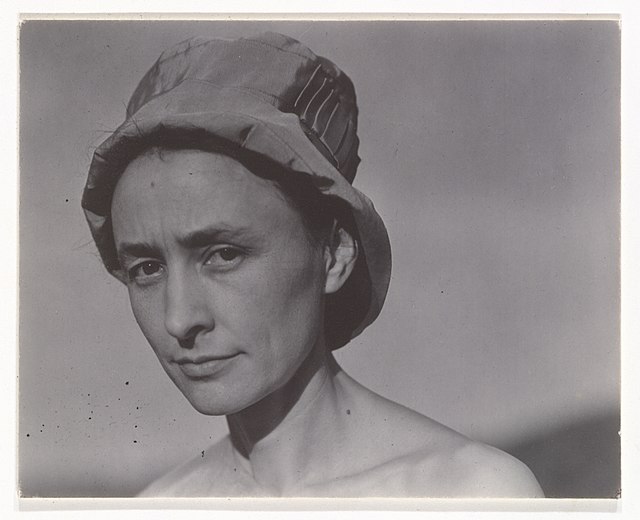
Georgia O’Keeffe, a towering figure in American modern art, is renowned for her distinctive representation of nature, skyscrapers, and southwestern landscapes. Born on November 15, 1887, in Sun Prairie, Wisconsin, O’Keeffe would go on to challenge the boundaries of modern American artistic expression. Her career, which spanned much of the twentieth century, was marked by a profound commitment to creativity, innovation, and independence.
Early Life and Education
O’Keeffe’s interest in art began at an early age. Encouraged by her mother, she started formal art training at the age of 10. After graduating from high school, she attended the Art Institute of Chicago and later the Art Students League in New York City, where she learned realist painting techniques. Disenchanted with the imitation of nature that her training emphasized, O’Keeffe began to explore personal expression, leading to a pivotal shift in her artistic direction.
In 1912, O’Keeffe attended a summer class at the University of Virginia, where she was introduced to the ideas of Arthur Wesley Dow. Dow’s emphasis on composition and design over realistic representation had a significant impact on O’Keeffe, helping shape her distinctive abstract style. She began experimenting with the abstract, focusing more on shapes, lines, and light which marked the beginning of her unique approach to art.
Career Beginnings and Personal Life
O’Keeffe’s professional career was catalyzed by her relationship with the influential photographer and art dealer, Alfred Stieglitz. After he exhibited her work in 1916 without her permission, O’Keeffe moved to New York in 1918 at Stieglitz’s request and support. The couple eventually married in 1924. Stieglitz’s continuous promotion and support played a crucial role in establishing O’Keeffe’s reputation as a major artist. Their partnership, however, was both complex and collaborative, with Stieglitz organizing exhibitions for O’Keeffe annually and taking more than 350 portraits of her, contributing significantly to the public persona of O’Keeffe as an artist.
Artistic Themes and Innovations
O’Keeffe’s art is characterized by its blend of abstraction and representation. Her paintings often transform familiar subjects into unfamiliar, compelling compositions that challenge viewers’ perceptions. In the 1920s, she painted a series of urban landscapes and skyscrapers, reflecting her life in New York City. However, she is perhaps best known for her paintings of flowers. Magnified to a grand scale, these flowers often appear as abstract forms, simultaneously evoking the natural world and independent aesthetics.
In the mid-1920s, O’Keeffe began creating what would become some of her most famous works. These pieces often depicted large-scale flowers that at times appear to border on abstraction. Critics often interpreted these works as reflections of femininity and reproduction, an analysis that O’Keeffe both resisted and refuted throughout her career. She insisted that her work was about the form and light that she saw in her subjects, not a symbolic representation of anything else.
Love for the American Southwest
The landscapes of New Mexico, where O’Keeffe began spending part of her year in the late 1920s, inspired a new phase in her art. The stark landscape, distinct architectural forms, and indigenous art of the region profoundly influenced her aesthetic. In 1949, three years after Stieglitz’s death, O’Keeffe moved permanently to New Mexico. Her paintings from this period include iconic images of the southwestern landscape, such as the red hills, bleached bones, and desert skies. Works like “Ram’s Head White Hollyhock and Little Hills” (1935) and “Black Cross, New Mexico” (1929) reflect her deep connection to the land and her skill in capturing its essence.
Legacy and Influence
Georgia O’Keeffe passed away on March 6, 1986, in Santa Fe, New Mexico, leaving behind a vast body of work that has continued to influence generations of artists. Recognized as the “Mother of American modernism,” her legacy is preserved not only through her paintings but also by the Georgia O’Keeffe Museum in Santa Fe, established in 1997. Her work is celebrated for its bold technical experimentation, originality, and deep personal expression.
Georgia O’Keeffe remains an iconic figure in American art, her works a testament to a life lived through the lens of creativity. Her ability to see and depict the world in new ways made her one of the most innovative artists of the 20th century, and her paintings continue to captivate and inspire audiences around the globe. Through her art, O’Keeffe not only reshaped American modernism but also challenged the conventions of perception, making her one of the most compelling artists of her time.