
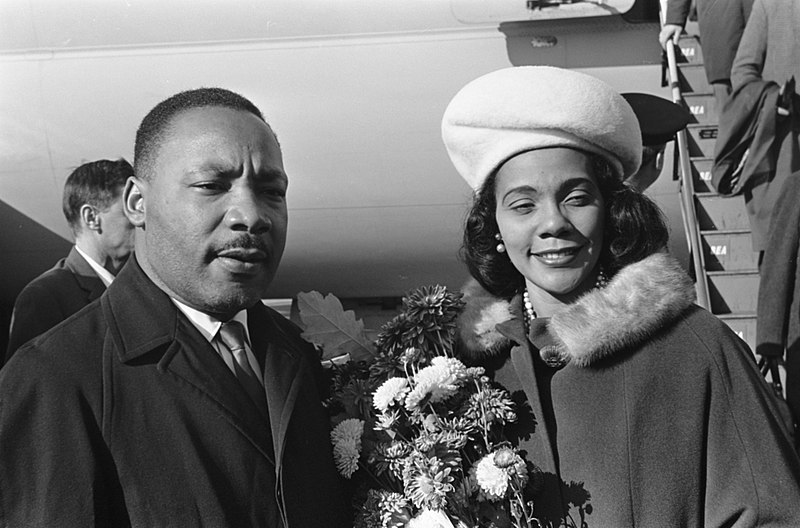
When we think of the Civil Rights Movement, Martin Luther King Jr. is often at the forefront of our minds. But behind the scenes and, ultimately, on the front lines herself, was his wife, Coretta Scott King. A powerhouse in her own right, Coretta was more than the wife of an iconic leader. She was an activist, artist, and humanitarian who carried forward Dr. King’s legacy while creating her own lasting impact on social justice and equality in America.
Early Life and Education
Born on April 27, 1927, in Heiberger, Alabama, Coretta Scott King grew up in the rural South in a family that understood the struggles of discrimination and segregation firsthand. Despite the obstacles of the time, Coretta was determined to get an education, going on to study at Antioch College in Ohio, where she became one of the few Black students on campus. She then received a scholarship to the New England Conservatory of Music in Boston, where she pursued her dream of becoming a professional singer and violinist.
It was during her time in Boston that she met Martin Luther King Jr., a doctoral student at Boston University. Their mutual commitment to social justice and shared values led to a deep bond, and they married in 1953. As a couple, they supported each other’s dreams and built a partnership based on their desire to create a fairer world.
Partner in the Civil Rights Movement
Coretta Scott King was an essential partner in Martin’s activism. Even as she raised their four children, Coretta remained a constant source of strength for her husband and often marched alongside him in protests, rallies, and boycotts. She supported his role in the Civil Rights Movement not only as his wife but as an activist in her own right. In 1955, when Martin was arrested for his leadership in the Montgomery Bus Boycott, Coretta reached out to friends, allies, and even influential leaders to secure his release.
Through the years, Coretta became an advocate for issues that intersected with civil rights, including gender equality and economic justice. She traveled widely, gave speeches, and met with global leaders to promote civil rights and peace. During the 1960s, Coretta even advocated for disarmament and protested against the Vietnam War, a stance that further solidified her commitment to nonviolence.
Continuing Dr. King’s Legacy After His Death
On April 4, 1968, when Martin Luther King Jr. was assassinated, Coretta’s world was shattered, but her resolve remained unbroken. In the wake of his death, she emerged as the torchbearer of his legacy, stepping into his role as a leader of the Civil Rights Movement. Only days after his assassination, Coretta led a protest march in Memphis in honor of her husband’s fight for economic justice.
Coretta became the founder and leader of the Martin Luther King Jr. Center for Nonviolent Social Change in Atlanta, which she established in 1968 as a way to memorialize her husband’s life and work. Through the King Center, Coretta preserved Dr. King’s work and made it accessible to future generations. She championed his commitment to nonviolence, ensuring that the center would serve as a living memorial, a place for learning, and a resource for ongoing social justice efforts.
Advocacy for a National Holiday
Perhaps one of Coretta Scott King’s most well-known achievements is her decades-long campaign to establish Martin Luther King Jr. Day as a national holiday. In 1983, after 15 years of tireless campaigning, her efforts paid off when President Ronald Reagan signed a bill into law, officially declaring the third Monday in January as Martin Luther King Jr. Day. Thanks to Coretta’s determination, Americans now honor Dr. King’s legacy and reflect on the importance of equality and nonviolent activism each year.
A Global Advocate for Human Rights
Coretta Scott King’s activism didn’t stop with civil rights for African Americans. She was an outspoken supporter of LGBTQ+ rights and a vocal advocate for women’s equality. In the 1980s, she became one of the first prominent civil rights leaders to openly support LGBTQ+ rights, calling them a matter of civil rights. She also spoke out against apartheid in South Africa and championed international peace and justice, meeting with leaders across the globe to advance human rights.
The Legacy of Coretta Scott King
Coretta Scott King’s dedication, courage, and advocacy were crucial not only in preserving Dr. King’s legacy but in expanding it to address new frontiers of social justice. She was a role model for women, especially Black women, in activism, showing them that they too had a place in the fight for justice. Coretta paved the way for future generations of female leaders, inspiring countless people to take a stand against injustice in their communities.
Today, the King Center continues her work, supporting initiatives for nonviolence, youth empowerment, and social change. Coretta’s life serves as a reminder that while individuals like Dr. King inspire movements, the people who stand beside them can be just as vital to carrying forward their mission.
Final Thoughts
Coretta Scott King was more than Martin Luther King Jr.’s wife; she was a pillar of strength, a visionary, and a fearless advocate for justice in her own right. Her legacy of resilience and activism reminds us that change is possible, but it requires unwavering commitment, courage, and a willingness to lead even in the face of personal loss. Coretta Scott King’s work resonates today as a beacon of hope, reminding us of the importance of love, justice, and equality for all. Her journey exemplifies the impact one individual can have on the world and the importance of carrying forward the fight for a fairer, more compassionate society.



