
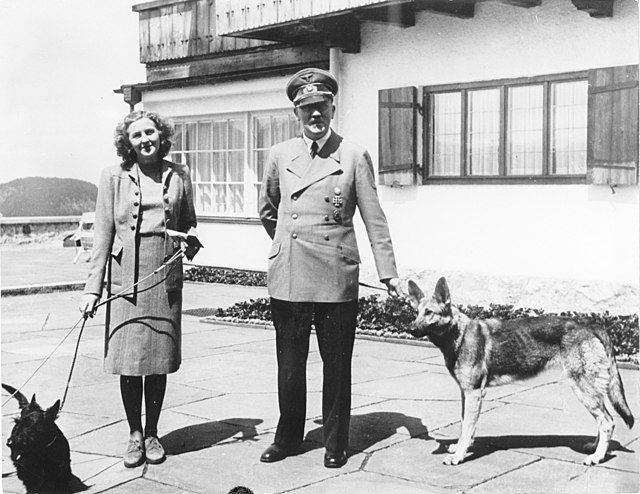


Eva Braun remains one of the most enigmatic figures in history, largely overshadowed by the horrific legacy of her husband, Adolf Hitler. While her life was lived in the shadow of one of the most notorious men in history, her relationship with Hitler offers a fascinating, albeit disturbing, insight into the personal life of the dictator. Braun spent much of her life as a private figure, yet her ultimate demise was entwined with the fall of the Third Reich.
This blog post explores the life of Eva Braun, her relationship with Hitler, and the tragic end she met in the infamous Führerbunker during the final days of World War II.
The Early Life of Eva Braun
Eva Braun was born on February 6, 1912, in Munich, Germany, into a middle-class Bavarian family. She had a fairly ordinary upbringing and was described as a lively, athletic, and independent young woman. After completing her education, she worked as a shop assistant and part-time photographer for Heinrich Hoffmann, who was Adolf Hitler’s personal photographer. It was through this job that Braun first crossed paths with Hitler in 1929, when she was just 17 years old.
At the time, Hitler was a rising political figure, and their initial relationship was not public. Over the next several years, Braun became more closely involved with Hitler, though she remained largely out of the political spotlight. She spent most of her time at Hitler’s mountain retreat, the Berghof, in Bavaria, living in relative isolation from the public eye and far removed from the horrors of Nazi rule.
The Secret Relationship with Hitler
Braun’s relationship with Hitler was a carefully guarded secret, especially during the early years. She rarely made public appearances with him and was kept away from the political and military operations of the Nazi regime. Despite this, Braun’s devotion to Hitler was unquestionable. She wrote letters to him expressing her love and, in the early years of their relationship, even attempted suicide twice—once in 1932 and again in 1935—likely out of frustration with her hidden and isolated life.
Although Hitler had numerous admirers and supporters, Eva Braun was the one constant companion in his personal life. Hitler, who believed that being single helped his public image, rarely acknowledged Braun in public. Yet, by all accounts, she was deeply devoted to him, and he, in his own way, valued her company as a retreat from the pressures of his public and political life. For much of the 1930s and 1940s, Braun lived a life of luxury, largely shielded from the atrocities being committed by the Nazi regime.
Becoming Mrs. Hitler: A Brief Marriage
As World War II neared its devastating conclusion and Allied forces closed in on Berlin, Hitler retreated to the Führerbunker, a fortified underground shelter. Eva Braun, displaying her loyalty to the bitter end, joined him in the bunker, refusing to leave his side even as the situation became hopeless.
It was during these final, frantic days in April 1945 that Hitler and Braun decided to marry. On April 29, 1945, they were wed in a brief civil ceremony within the confines of the bunker. Eva Braun had finally become Mrs. Hitler, though the marriage lasted less than 40 hours.
Their marriage was Hitler’s final gesture of devotion to Braun, but it was also a desperate move in the face of inevitable defeat. The following day, with Soviet forces surrounding Berlin and the Nazi regime in ruins, Hitler and Braun made a suicide pact.
The Tragic Demise in the Führerbunker
On April 30, 1945, just one day after their marriage, Adolf Hitler and Eva Braun committed suicide together in the Führerbunker. Hitler took cyanide and shot himself, while Braun ingested a cyanide capsule. Their bodies were discovered shortly afterward by Hitler’s staff, who carried out his final wishes by burning the remains to prevent them from falling into Soviet hands.
The suicides marked the end of the Third Reich and signaled the collapse of Nazi Germany. Eva Braun, a woman who had lived in the shadow of Adolf Hitler for most of her adult life, met her end alongside the man she had devoted herself to for years.
The Legacy of Eva Braun
In the years since her death, Eva Braun has remained a largely forgotten figure in the historical narrative of World War II, overshadowed by Hitler’s atrocities and the larger horrors of the Holocaust. While she was not directly involved in the political and military decisions of the Nazi regime, her role as Hitler’s companion places her in a unique position in history.
Some historians argue that Braun was a passive figure, more interested in her personal life than the political machinations surrounding her. Others suggest that her silence and proximity to power implicate her, at least indirectly, in the crimes of the regime.
Ultimately, Eva Braun’s life remains a tragic and complex story. She lived a life of luxury and privilege while the world around her descended into chaos, and in the end, she chose to die alongside the man responsible for some of the greatest atrocities in human history. Her legacy, like her life, is defined by her relationship with Adolf Hitler—a relationship that ultimately led to her demise.
Final Thoughts: A Woman in the Shadows of History
Eva Braun’s life is one of contradictions: a woman who lived in the lap of luxury while the world was at war, a figure who remained largely apolitical yet was intimately connected to one of the most destructive political regimes in history. Her story is a haunting reminder of the complexities of human relationships and the personal choices that shape history.
Though often overshadowed by the larger narrative of World War II, Eva Braun’s life and tragic end offer a unique perspective on the personal lives of those in power and the consequences of loyalty to a tyrant.



