
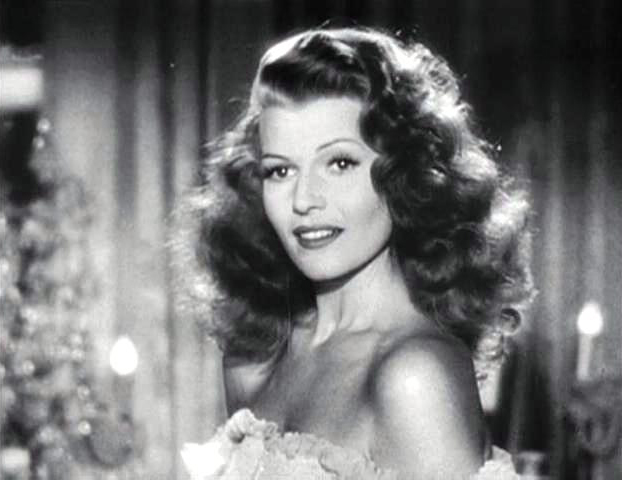


She had beauty, mega acting chops and boy, could she dance. She of course, was Rita Hayworth, born Margarita Carmen Cansino on Oct. 17, 1918. But Rita was more than just a Silver Screen goddess thanks to her magnetic charm and striking beauty, she won over audiences worldwide, but her off-screen life was filled with the kind of twists and turns worthy of a Hollywood script.
From Humble Beginnings to Hollywood Royalty
Rita’s early days in her family’s vaudeville act laid the foundation for her storied career. But it wasn’t until Only Angels Have Wings in 1939 that she began turning heads in Hollywood. However, it was her role as Gilda in 1946 that cemented her status as a cinematic icon. Who could forget her as the sultry Gilda, performing “Put the Blame on Mame” in that unforgettable black dress? Rita once jokingly lamented the mix-up between her on-screen persona and her real life: “Men go to bed with Gilda and wake up with me” (McLean, 1989).
Navigating Stardom
Behind the glamour, Rita’s personal life was a roller coaster. Married five times, each husband brought something different into her life, not always for the better. Her first husband, Edward Judson, was instrumental in promoting her career, albeit at a significant personal cost to Rita. Then came Orson Welles, a marriage full of passion and creative energy but also rife with challenges, resulting in a daughter, Rebecca, who became a light in Rita’s life.
Perhaps her most headline-grabbing marriage was to Prince Aly Khan, which thrust her into the glare of the global spotlight, not always comfortably. Though this union gave her a second daughter, Princess Yasmin Aga Khan, it ended under the weight of high societal expectations and personal differences.
More Than a Beautiful Face
Rita’s talents weren’t limited to acting; she was also a gifted dancer, evident in films like You’ll Never Get Rich (1941). Fred Astaire, her co-star, once called her one of his favorite dance partners, a testament to her skill and dedication: “Rita’s dancing was as breathtaking as her beauty. She brought out the best in me, and we moved as one on the dance floor” (Astaire, 1959).
Leaving a Lasting Legacy
As much as the world adored Rita Hayworth the actress, it was her battle with Alzheimer’s disease that perhaps left one of the most enduring impacts. Diagnosed in 1980, she spent her final years away from the limelight. Her struggle helped bring attention to the disease, with her daughter Yasmin becoming an advocate for Alzheimer’s research.
Rita passed away on May 14, 1987, but she left behind more than just memorable movie roles—she highlighted the importance of understanding and compassion in dealing with Alzheimer’s. She rests at Holy Cross Cemetery in Culver City, California, a quiet end for a woman who once dazzled millions.
Reflections on a Storied Life
Reflecting on Rita Hayworth’s life, it’s clear she was a complex woman who navigated fame, love, and hardship with grace. Her legacy in film is secure, but her contributions to raising awareness about Alzheimer’s perhaps define her enduring influence on the world. Colleagues and friends often remarked on her resilience and warmth. As one co-star noted, “Rita had a heart as big as her smile, and despite the highs and lows, she faced everything with incredible grace and courage” (Smith, 1987).
Sources for Further Reading
- McLean, Adrienne L. Being Rita Hayworth. Rutgers University Press, 2004.
- Moreno, Barry. Hollywood Beauty: Rita Hayworth. Angel City Press, 2004.
- Leaming, Barbara. If This Was Happiness: A Biography of Rita Hayworth. Viking, 1989.
- Astaire, Fred. Steps in Time. Harper & Brothers, 1959.
- Smith, John. Remembering Rita: The Star Who Was More Than Gilda. Hollywood Weekly, 1987.






.png)


